

The PSL Tiers Explained: Subhuman, Normie, Chadlite & Chad
5 min read
PSL tiers are informal appearance labels used in some looksmaxxing and face-rating communities. If you have seen “Subhuman,” “normie,” “HTN,” or “Chadlite” in a comment and wondered what they mean, this guide explains the vocabulary and the limits of the charts behind it.
Lookmax Analyzer currently does not use PSL tiers. This guide explains community slang. Our reports use feature categories and do not assign these labels or convert scores to PSL.
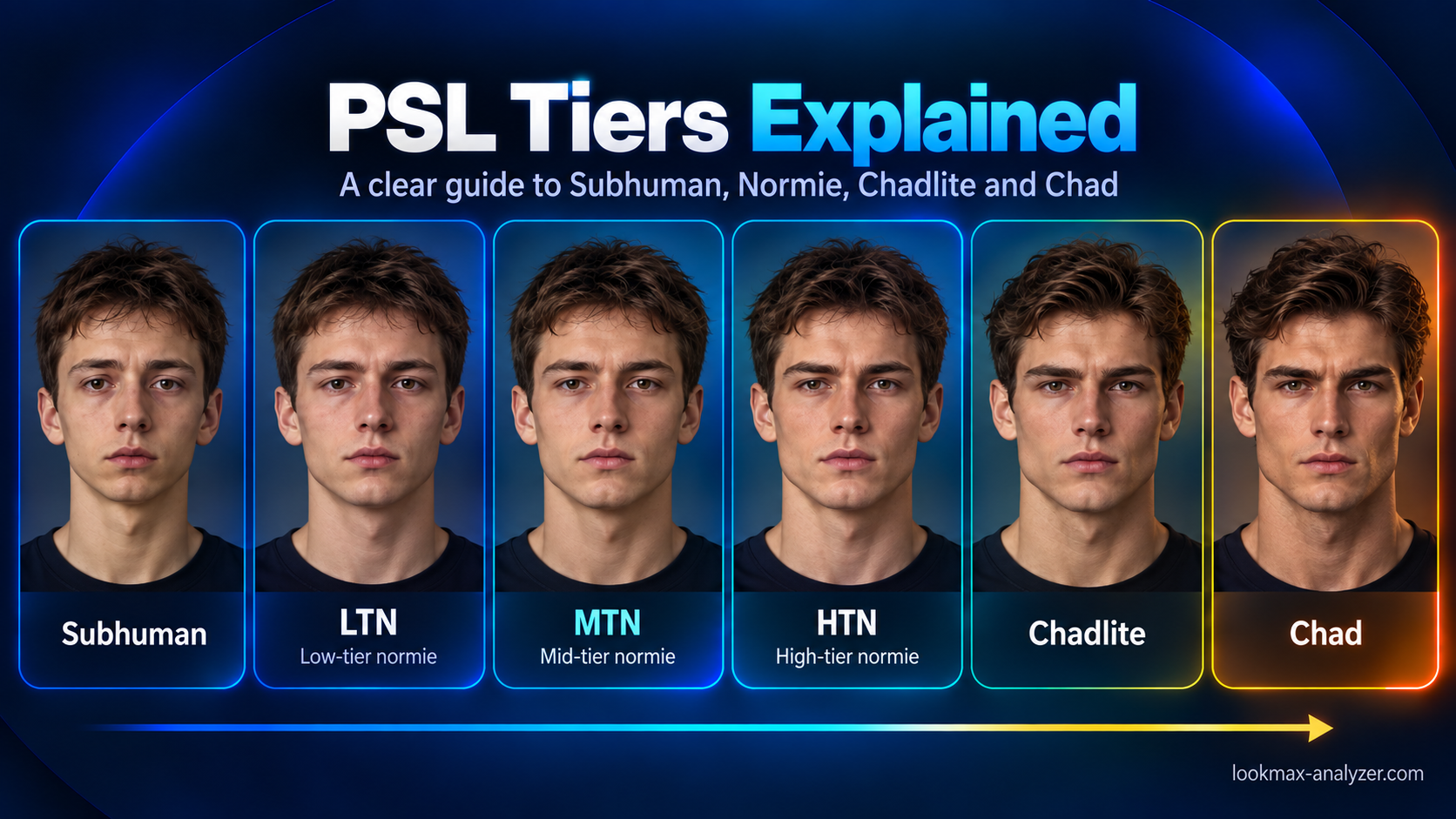
Illustrative examples of PSL community labels, not standardized facial categories. Lookmax Analyzer does not use these tiers. Open the image to view it at full size.
What is the PSL scale?#
The PSL scale is a community-made framework for ranking perceived facial attractiveness. Its terminology grew out of looks-focused forums, including incel and lookism spaces, and later spread through social media. Know Your Meme’s overview documents that background and one detailed version of the hierarchy.
PSL historically refers to PUAhate, Sluthate and Lookism, the forum names associated with it. You may also encounter the later expansion “Proportion, Size and Lineation.” An acronym that sounds technical does not make the underlying judgments a scientific standard.
A PSL discussion often mixes two things: a number and a tier name. Neither has a universal definition. Before interpreting a rating, you would need to know which chart the commenter is using, what they are judging, and how the photo was taken.
PSL tiers chart: the common labels at a glance#
The table below is a vocabulary guide. It describes the usual ordering of these terms, not a set of verified score boundaries or population percentiles.
| Tier | Meaning in community charts |
|---|---|
| “Subhuman” | A dehumanizing label placed at the bottom of some charts. |
| LTNLow-tier normie | The lower part of the community’s ordinary-looking range. |
| MTNMid-tier normie | The middle part of that range. |
| HTNHigh-tier normie | The upper part of that range. |
| ChadliteAlso called CL | An attractive tier usually placed above HTN and below Chad. |
| Chad | A highly attractive male archetype in the hierarchy. |
| Adam / EveOptional upper tiers | Idealized top labels included in some extended charts. |
Some versions use Becky for normie tiers and Stacylite / Stacy alongside Chadlite / Chad. “Sub-5” also appears, but its meaning depends on the numbered scale being used. These variants help explain why two posts can use familiar terms while disagreeing about their boundaries.
What each PSL tier means#
“Subhuman”: what the label means, and why we do not use it
This is the most degrading term in the hierarchy. We include it because readers encounter it online and search for its meaning. It is not a legitimate description of a person’s humanity, health, or worth. Calling someone this does not explain any measurable feature or provide useful feedback.
If that word appears under your photo, the comment tells you about the language the commenter chose. It does not establish a fact about you.
Normie: LTN, MTN and HTN
“Normie” is broader internet slang; in a PSL chart, it becomes a tier label subdivided into low, mid and high. The shorthand makes a long ranking discussion easier to compress, but it hides how the judgment was reached.
Two commenters might agree on “HTN” while disagreeing completely about the person’s eyes, jawline or proportions. A label alone cannot tell you whether a perceived weakness comes from facial structure, expression, grooming, lighting or camera perspective.
Chadlite vs. Chad
The suffix “lite” indicates a lower position than the full Chad label. What separates the two depends on the chart and the rater. There is no single jaw angle, eye shape or symmetry measurement that automatically earns either term.
You will sometimes see lists of required traits presented as rules. Those lists still need choices about reference ranges, photo quality and the importance of each feature. Agreement within a community should not be mistaken for universal agreement about attractiveness.
Becky, Stacy and the extended upper tiers
Gendered variants add more vocabulary, but they do not solve the measurement problem. They are useful to recognize when reading a discussion; they should not be treated as identities you need to adopt or as targets that a face-analysis tool can guarantee.
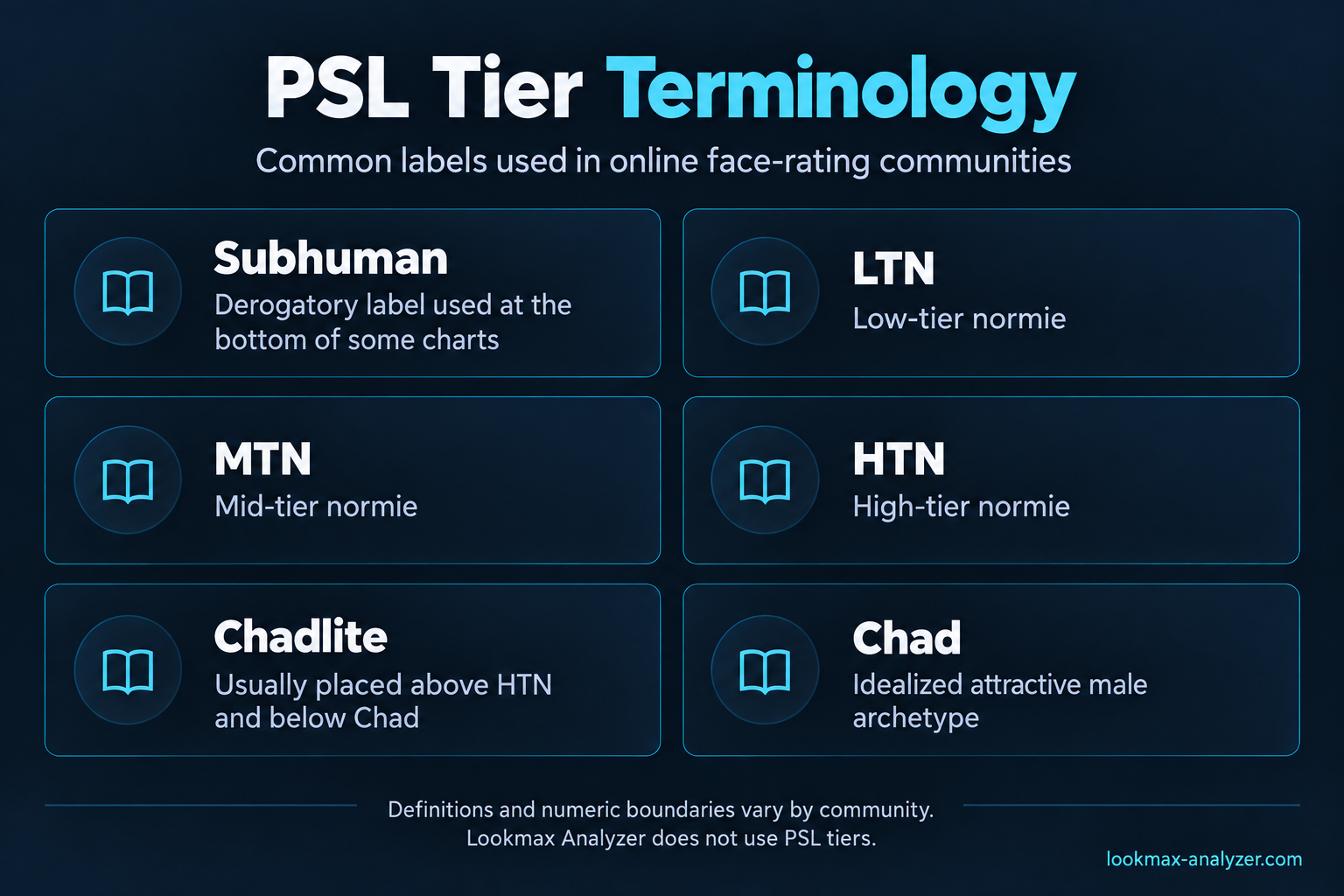
Common PSL terms and abbreviations. Definitions and numeric boundaries vary by community. Open the image to view it at full size.
PSL score ranges: why 8-point and 10-point charts disagree#
Both 8-point and 10-point versions circulate. The same written number can therefore mean different things. Even charts with the same maximum can divide their tiers differently. For an example of how people disagree about the mapping, see this community discussion of the rating scale.
Three details matter when reading a numeric PSL chart:
- Scale: is the number out of 8, out of 10, or part of another convention?
- Boundaries: where does that particular chart put LTN, HTN or Chadlite?
- Evidence: is the rating based on one selfie, multiple standardized photos, or an unsupported impression?
For those reasons, we do not publish a universal “PSL score to tier” conversion. A decimal place can make an opinion look precise without making it repeatable. Likewise, a chart claiming that a tier represents the “top 1%” needs a representative population study behind that claim. The label alone supplies no such evidence.
If you meant an ordinary 10-point rating rather than PSL, our 7/10 attractiveness guide explains that separate convention and its limitations.
PSL tiers vs. Lookmax Analyzer’s face analysis#
We currently do not use PSL ratings, PSL tiers or a PSL calculator. Our reports use a separate photo-based scoring model with five displayed structural categories: Jawline, Eyes, Cheekbones, Symmetry and Proportions.
That distinction matters when interpreting your report:
- A category result describes how the visible evidence fits our model’s references.
- The overall score summarizes those categories under the selected context; it is not a PSL tier.
- Eligible apparent-age evidence can separately affect the presented total. Skin feedback is separate and does not contribute to the face total.
- An 80/100 result does not mean 8 PSL, “Chad,” or the 80th attractiveness percentile.
- A report does not establish your social standing or predict dating success.
Our model also has limits. Photo conditions and uncertain measurements can affect the result, and we do not claim that the remaining overestimation or population standing is calibrated. A category breakdown offers more explanation than a status label, but it remains a model’s interpretation of a photo.
For the method behind the report, read how our face score is calculated. For differences between tools, see why your face score changes in different apps.
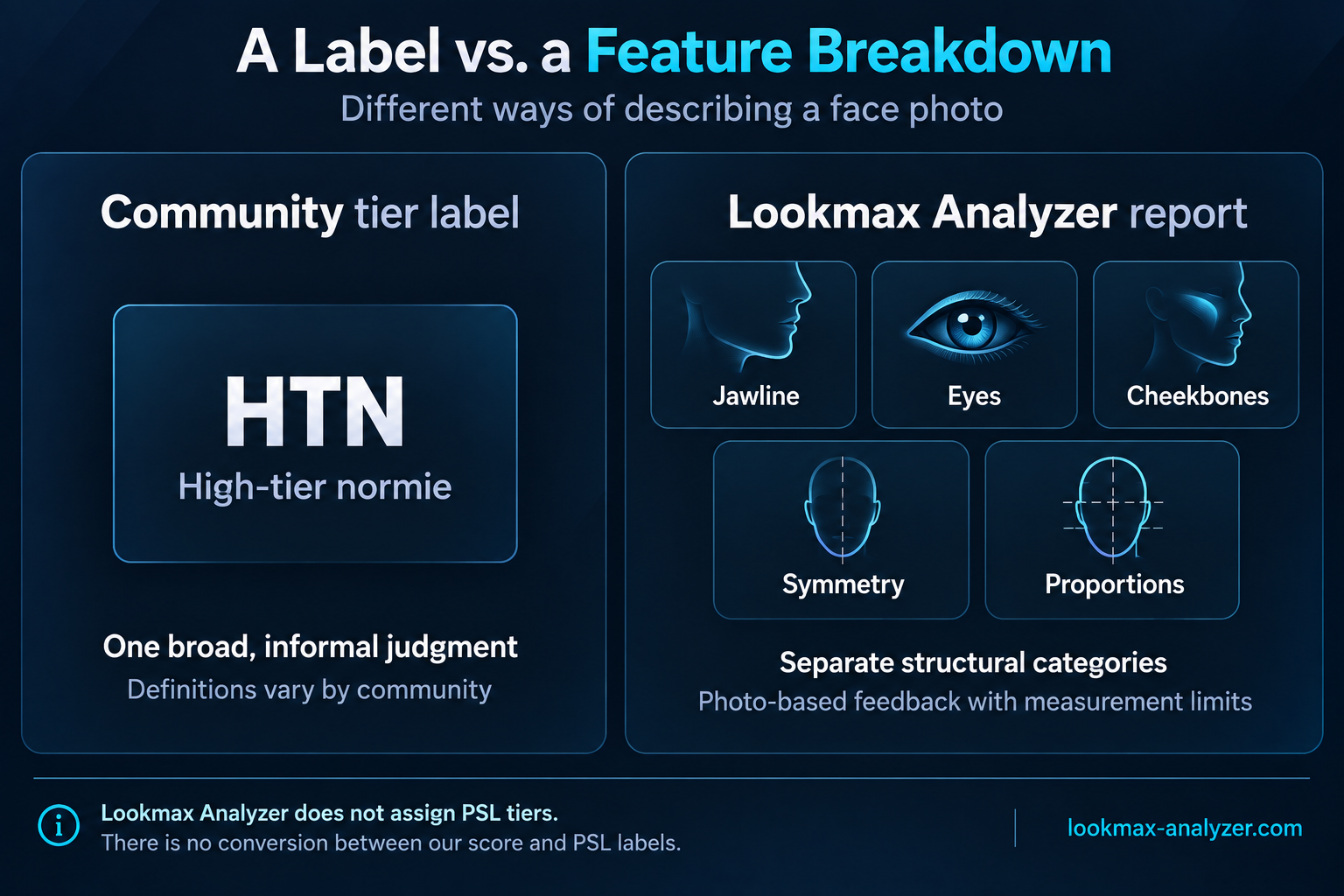
A community label and a feature breakdown describe different approaches. There is no conversion between our score and PSL labels. Open the image to view it at full size.
A more useful next step than finding your tier#
Start with the question you actually want answered. “Is this photo distorting my proportions?” and “Which grooming choices suit my face?” lead to more specific feedback than “What tier am I?”
If you choose to analyze a photo, use even lighting, a relaxed expression and a near-frontal view. Our face-photo guide explains the setup. Avoid treating small changes between uploads as changes in your identity or appearance; first check whether the capture conditions changed.
Then look at the explanation behind the result. Use the PSL glossary entry to decode slang and the facial-features guide to understand the categories. You do not need a community label to make practical choices about presentation.
Understand the features behind your score
Explore your Jawline, Eyes, Cheekbones, Symmetry and Proportions breakdown.
Explore Your Face Feature BreakdownFrequently asked questions about PSL tiers#
What are the PSL tiers?
Common labels include Subhuman, low-tier normie (LTN), mid-tier normie (MTN), high-tier normie (HTN), Chadlite and Chad. Some charts add Adam or use Becky, Stacy and Eve variants. The labels and numeric cutoffs vary by community.
What does normie mean on the PSL scale?
In PSL discussions, normie refers to the ordinary-looking range within that community’s hierarchy. LTN, MTN and HTN mean low-, mid- and high-tier normie. These are informal judgments, not verified population rankings.
What is the difference between HTN and Chadlite?
Charts generally place Chadlite above high-tier normie (HTN). The distinction is a community judgment about perceived appearance, and there is no universal measurement or score boundary separating them.
Is the PSL scale out of 8 or 10?
Both versions circulate online. A number only makes sense alongside the specific chart and its rules; dividing an unrelated face score by ten does not produce a PSL rating.
Does Lookmax Analyzer use PSL tiers?
No. Lookmax Analyzer currently does not use PSL tiers or assign labels such as Subhuman, normie or Chad. Reports use our own photo-based score and structural categories, with no conversion to PSL.
Does an 80/100 face score mean Chad?
No. Lookmax Analyzer scores are not PSL ratings, validated attractiveness percentiles or predictions of dating success. There is no supported mapping from our score to a PSL tier.
Sources and further reading#
- Know Your Meme: PSL Scale — background and one documented chart, used here to explain terminology rather than endorse its claims.
- Community discussion: explaining the looks rating scale — an example of differing score conventions, not scientific validation.
- Lookmax Analyzer: what does PSL mean? — our neutral glossary entry and report-language policy.