

Why Your Face Score Changes in Different Apps (And Which One to Trust)
3 min read
By Lookmax Analyzer Team - Updated Apr 18, 2026
Why Your Face Score Changes in Different Apps
The problem#
Same face. Same photo.
One app says 6/10. Another says 8.2.
TikTok? 5.
So... which one is actually correct?
The answer: none of them are absolute truth - each score is just a model's interpretation. Each app sees your photo through a different system, so the result changes.
A single score is a compressed guess, not a full explanation.
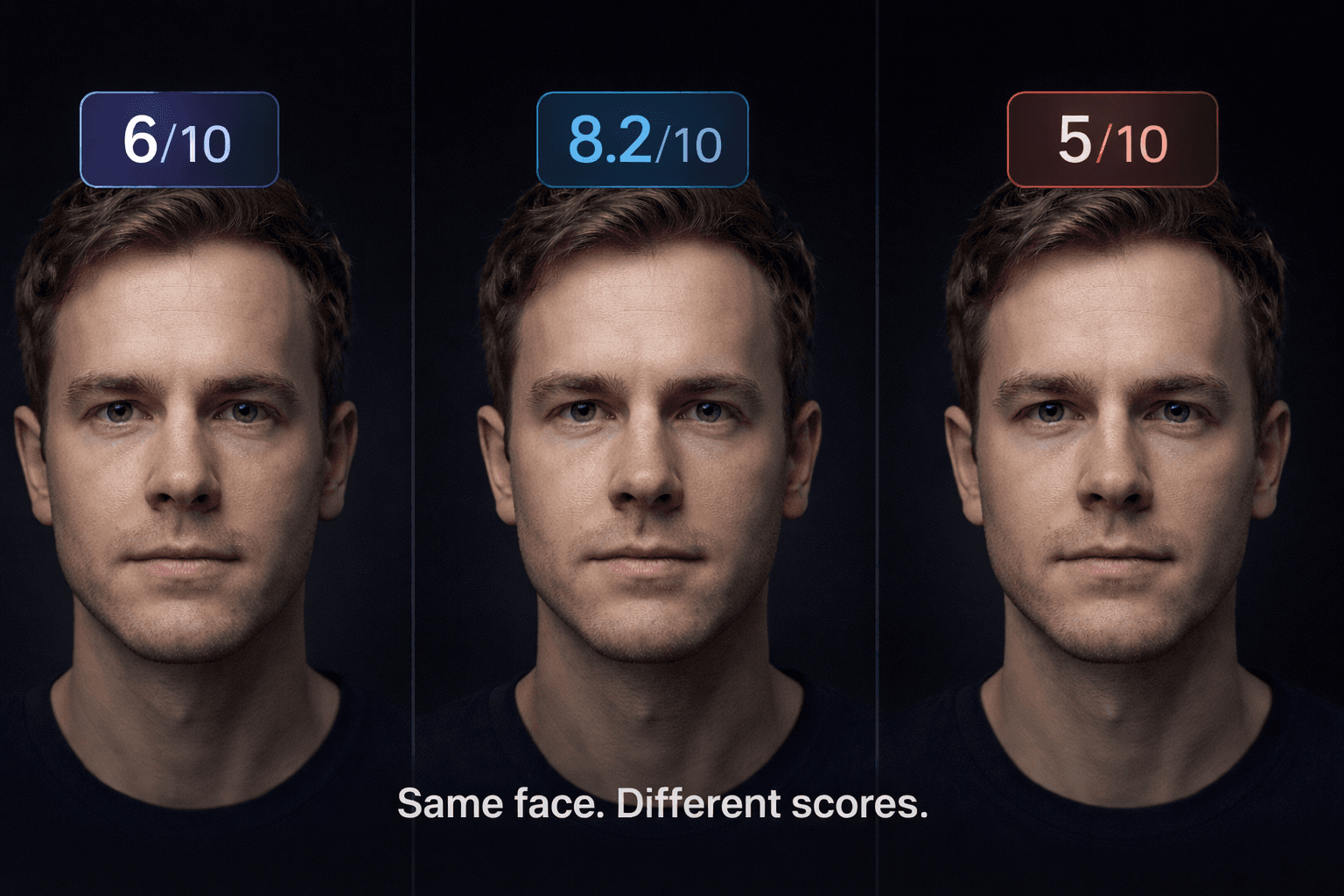
One face photo can produce different scores across different app pipelines.
Why scores change#
Score variation is normal. Different apps disagree because they use different assumptions, training data, and scoring formulas.
1) Different AI models
Not all face rating apps use the same engine. Some models evaluate facial symmetry narrowly, while others score multiple categories.
- Some apps use basic landmark detection only.
- Some focus mostly on left-right symmetry.
- Some use broader models trained on aesthetic preference datasets.
- Each model is optimized for different goals, so outputs will diverge.
2) Photo processing differences
Before scoring, apps preprocess your image in different ways.
- Lighting normalization can brighten or flatten facial contrast.
- Face alignment can rotate and recenter landmarks differently.
- Cropping rules can include or exclude jawline, forehead, or hairline.
- Compression and filter artifacts can shift detected feature boundaries.
3) Camera distortion
Camera geometry can change how your structure appears even before AI sees the image.
- Selfie cameras often use wider lenses than rear cameras.
- Close distance exaggerates nose size and narrows jaw appearance.
- Focal length changes relative proportions across the face.
- Distortion can make jawline geometry look different than it is.
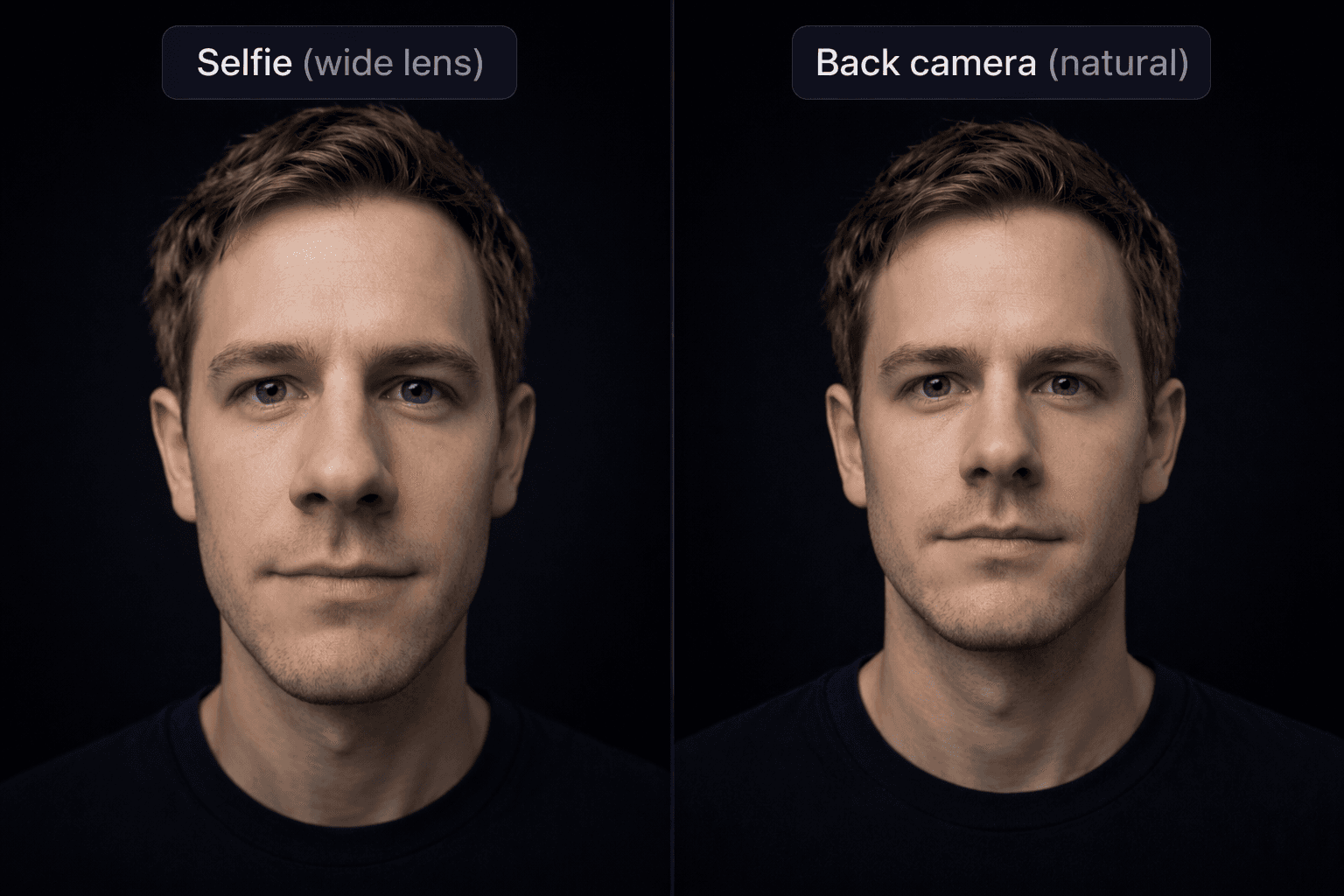
Selfie lens perspective can change perceived proportions versus a back-camera shot.
4) Scoring logic differences
Apps also differ in what they reward.
- One tool may heavily weight symmetry.
- Another may prioritize jawline geometry.
- Another may emphasize facial proportionslike eye spacing or lip ratios.
- Some models also put extra emphasis on cheekbone structure.
- Different weights produce different totals, even from the same face.
Advanced systems analyze hundreds of facial landmarks, proportions, and structural ratios - not just symmetry alone.
5) Hidden bias and training data
Every model inherits the dataset it was trained on.
- Gender bias can skew expected feature ranges.
- Ethnicity bias can reduce fairness across populations.
- Social media beauty trends can overfit toward a narrow "Instagram face" look.
Put simply: each app is measuring a different version of your face - processed differently, weighted differently, and judged against different standards.
What to trust instead#
Focus on explainability over a single number.
A reliable analysis does not just give you a score - it shows you:
- what increased your score
- what lowered it
- and what you can improve
This is the difference between a guess and a useful result.
Trust explainability over drama. If an app cannot tell you why you got a result, it is less useful for real improvement.
If you want to see this breakdown on your own face...
Practical setup for consistent scores#
- Use the same photo across all apps when testing differences.
- Avoid close-range selfies; prefer the back camera at eye level.
- Use a neutral expression (no smile, no squint, no raised brows).
- Keep lighting soft and even.
- Repeat under the same setup and compare trends, not one result.
Related reads: How to take a good face photo and How face score is calculated.
App type comparison#
| App type | What it measures | Common problem |
|---|---|---|
| TikTok filters | Visual effect and engagement cues | Not a stable scoring pipeline |
| Simple rating apps | Mostly symmetry or lightweight landmarks | Miss deeper structure and category context |
| Advanced AI analysis | Multi-metric scoring with category breakdowns | Requires standardized photo setup for best consistency |
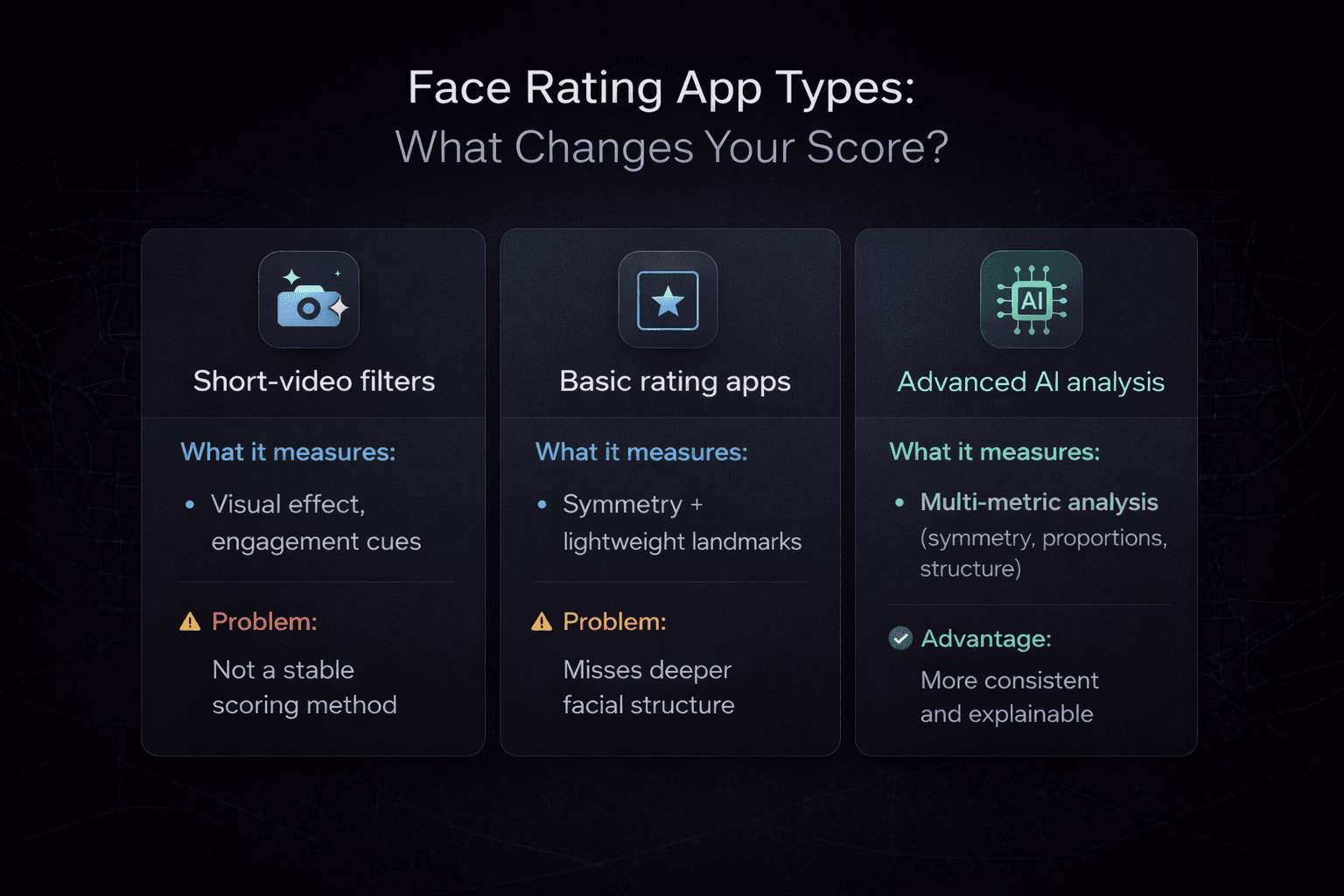
Different app types use different logic, so their score reliability differs.
Are face rating apps accurate?#
Face rating apps are useful for directional feedback, not absolute truth. They can highlight trends in symmetry, proportions, and structure, but each score still depends on capture conditions and model design.
In practice, accuracy improves when you standardize the photo setup and compare repeated results over time.
Which face rating app is most accurate?#
The most accurate app is usually the one that explains why you got a score. Look for category breakdowns, stable photo instructions, and trend tracking across multiple uploads instead of one dramatic number.
Can you trust your face score?#
- A single score is not absolute truth.
- Scores are useful for direction, not identity.
- Best approach: track trends over time.
If you are comparing an app score with labels like LTN, HTN or Chadlite, read our PSL tiers guide. It explains the community terminology and why our face score does not convert into a PSL rating.
Frequently asked questions#
- Are face rating apps accurate?
They can be directionally useful, but not absolute. Results depend on model design, camera geometry, preprocessing, and your photo setup.
- Why do I look worse in selfies?
Selfies are often taken too close with a wide lens. That perspective can distort facial proportions and lower consistency in face rating apps.
- Which face rating app is the most accurate?
The most accurate tools are explainable, use multi-metric scoring, and stay consistent across repeated photos.
- Why does my score change between TikTok and AI apps?
TikTok-style tools are often optimized for visual effect and speed. Dedicated analysis tools usually run deeper scoring pipelines, so the outputs will differ.