

Is My Face Attractive?Understanding the Feedback
No single photo or score settles whether a face is attractive. A measurement can describe visible structure; preference, expression, and context also shape the impression. This guide explains how to read the feedback.
Face potential
What People Mean by “Face Potential”
Face potential is not a prediction of a future face or a separate hidden rating. Here, it means separating the visible structural signals that tend to stay relatively stable from photo and presentation factors you can control.
Relatively stable signals
Jaw and chin support, facial symmetry, eye-area geometry, cheekbone structure, and proportions form the structural baseline visible in a suitable photo.
Changeable presentation factors
Lighting, camera distance, expression, grooming, hairstyle, skin care, posture, and styling can change how clearly those signals are presented.
The AI facial analyzer offers a free score preview, your strongest visible signal, and photo confidence. The complete category breakdown and main limiter belong to the optional paid report. For a practical first task, use the looksmaxing starting guides.
Inside the result
What Shapes a Photo-Based Attractiveness Result
The score starts with five displayed structural categories. Capture quality affects how clearly they can be measured, while your selected reference profile provides interpretation context.
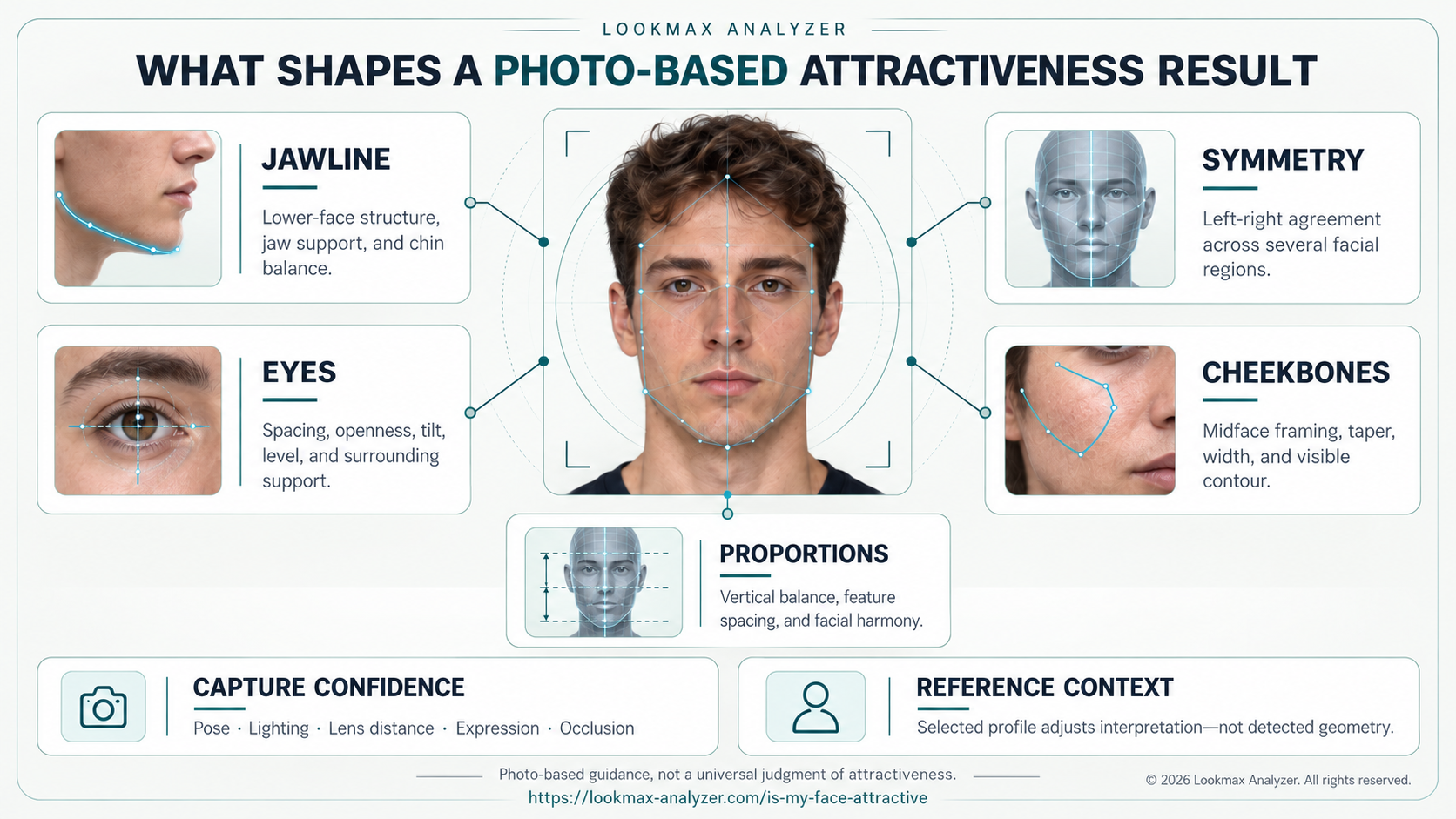
Attribution does not grant reuse rights. Read the image reuse terms.
Text breakdown of the result factors
Category 1
Jawline
Lower-face structure, jaw support, and chin balance.
Category 2
Symmetry
Left-right agreement across several facial regions.
Category 3
Eyes
Spacing, openness, tilt, level, and surrounding support.
Category 4
Cheekbones
Midface framing, taper, width, and visible contour.
Category 5
Proportions
Vertical balance, feature spacing, and facial harmony.
Capture confidence
Pose, light, lens distance, expression, and occlusion affect how much reliable evidence the photo provides.
Reference context
Gender and presentation goal adjust scoring references and weighting; they do not change the detected geometry.
What Each Signal Means—and What Can Distort It
A useful attractiveness test separates measured structure from photo setup and changeable presentation. That makes the result easier to interpret and less likely to be mistaken for a fixed verdict.
| Signal | What it represents | What can shift it | How to use it |
|---|---|---|---|
| Symmetry | Measured left-right agreement | Head turn, expression, uneven light | One structural category, not the whole face |
| Proportions | Vertical and horizontal balance | Lens distance, angle, hidden hairline | Context for how features fit together |
| Jawline | Jaw and chin support | Head position, facial hair, perspective | Read against the selected presentation goal |
| Eyes | Eye-area spacing, level, openness, and tilt | Squinting, shadow, expression, glasses | A feature-local category |
| Cheekbones | Midface width, taper, and contour | Head turn, light direction, hair coverage | Structural evidence with photo uncertainty |
| Presentation | Grooming, skin appearance, styling, and expression | The chosen photo and day-to-day choices | Changeable context, not a bone-structure score |
How to Interpret Your Face Score
Score
A 0-100 orientation estimate for the visible evidence in one photo—not a percentile or diagnosis.
Pattern
The spread across categories explains more than a one- or two-point change in the total.
Priority
The main limiter is the first area to review, not proof that every other feature needs work.
Progress
Compare similarly framed photos; otherwise camera changes can look like appearance changes.
See the full face-score methodology for category definitions and model boundaries.
How to Get a More Reliable Result
Large changes between differently framed photos often reflect capture conditions, not a real change in your face.
Why Your Own Face Is Hard to Judge
A mirror shows the reversed face you know best, while a camera adds lens distance, lighting, angle, expression, and a frozen moment. Those differences can make the same face look unfamiliar.
Social comparisons add another bias because selected, edited, and differently lit photos are rarely comparable. Use photo feedback to organize visible signals, not to settle your attractiveness as a fact.
Accuracy, Privacy, and Boundaries
The analyzer estimates visible geometry from a two-dimensional photo. It cannot fully measure facial depth, movement, real-life presence, or subjective preference.
Core landmark analysis runs in your browser. Your photo is shared only if you explicitly opt into a separate feature that requires photo processing; see the privacy details for each feature.
The result is not medical, psychological, or cosmetic advice, and it should not be treated as a universal standard of beauty.
Frequently Asked Questions
Can AI really tell if my face is attractive?
AI can estimate measurable factors like symmetry, proportions, and visible structure. It cannot turn attractiveness into a perfect truth because taste, culture, expression, and style still matter.
What is a good face score?
A face score is best read as an orientation estimate for one photo, not as a percentile or universal attractiveness rank. The category pattern, strongest feature, main limiter, and photo quality provide more useful context than the total alone.
How is a face score calculated?
Lookmax Analyzer starts with five structural categories: jawline, symmetry, eyes, cheekbones, and proportions. The selected reference profile and eligible photo-based presentation evidence can also affect the total. It is not a complete measure of appearance.
Why do I look better in the mirror than in photos?
The mirror shows the flipped version you are used to seeing. Photos can also distort your face because of lens type, distance, angle, posture, and lighting.
Can I improve my attractiveness?
Grooming, hairstyle, and styling can change presentation, but a photo score cannot predict the effect of a particular change or guarantee how other people will respond.
What does face potential mean?
Face potential is not a prediction or a separate hidden rating. It is a practical way to distinguish relatively stable structural signals from photo setup, grooming, styling, and presentation factors that can change.
Does gender or styling goal change the analysis?
Your selected reference profile and presentation goal can change how some category results are interpreted and weighted. They do not change the facial geometry detected in the photo or turn the result into an identity judgment.