

How Is a Face Score Calculated? 478 Landmarks Explained
3 min read
By Lookmax Analyzer Team — Updated Sep 15, 2026
How Is a Face Score Calculated From 478 Facial Landmarks?
This AI face analysis tool uses 478 facial landmarks to estimate visible facial harmony from symmetry, facial proportions, eye area, cheekbones, and jawline geometry.
Understanding how your face score is calculated helps you interpret your results more accurately.
Overview#
When you upload a photo, our AI evaluates your face across five key categories:
Each category receives a score between 0–100. The overall face score considers those category results together, then applies context and confidence safeguards so one isolated or uncertain observation does not decide the result.
Your score is a photo-based estimate of facial harmony, not a fixed judgment of attractiveness, identity, or personal value.
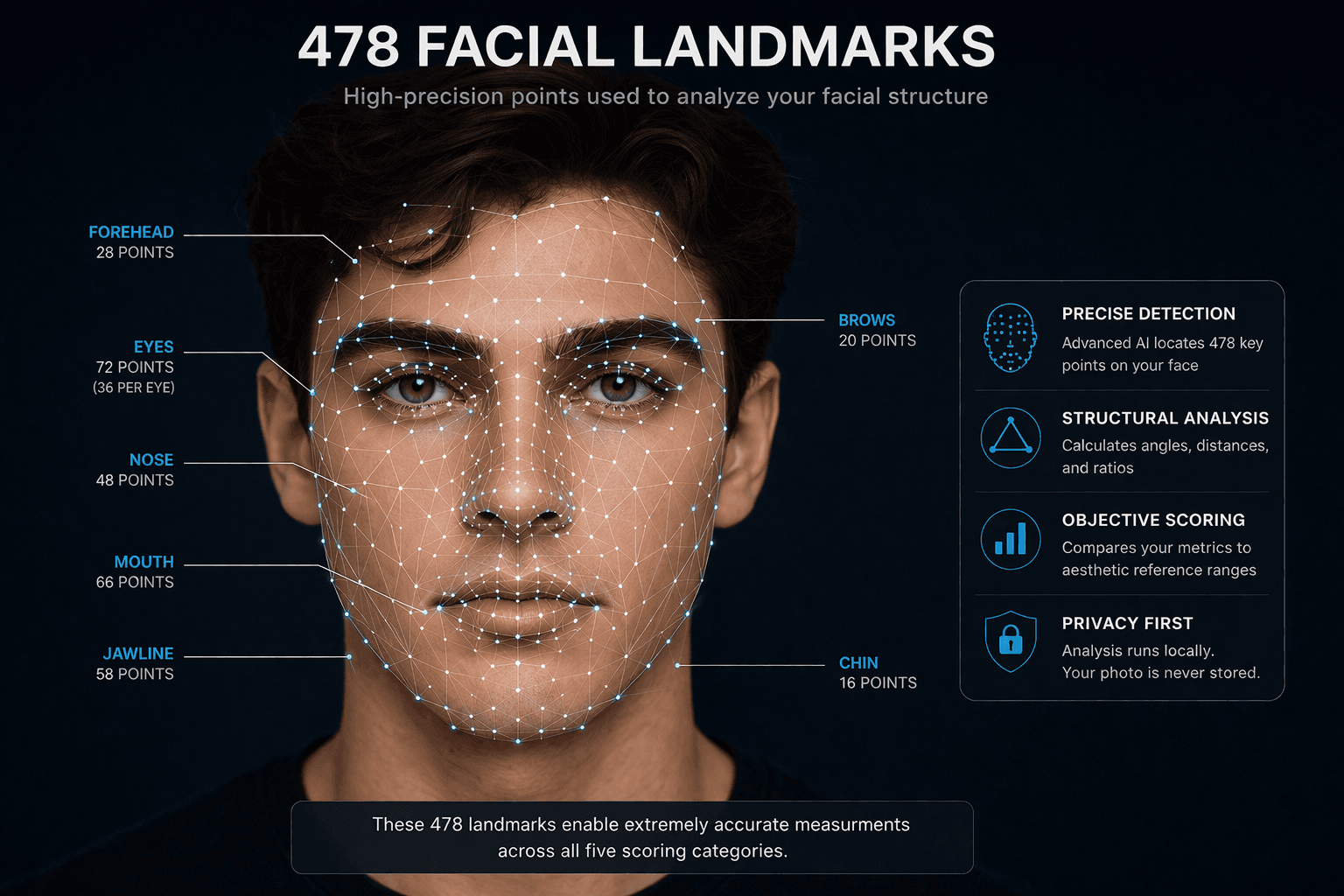
478 facial landmarks detected by our AI model
What We Measure#
1. Jawline
- Jaw angle
- Jaw width relative to face width
- Chin projection
Sharper and well-balanced jaw structures typically increase perceived facial definition.
2. Symmetry
Facial symmetry is one of the most studied traits in attractiveness research. We measure:
- Eye alignment
- Brow positioning
- Jaw cant
- Mouth centering
3. Eyes
- Eye size ratio
- Eye spacing ratio
- Eye openness
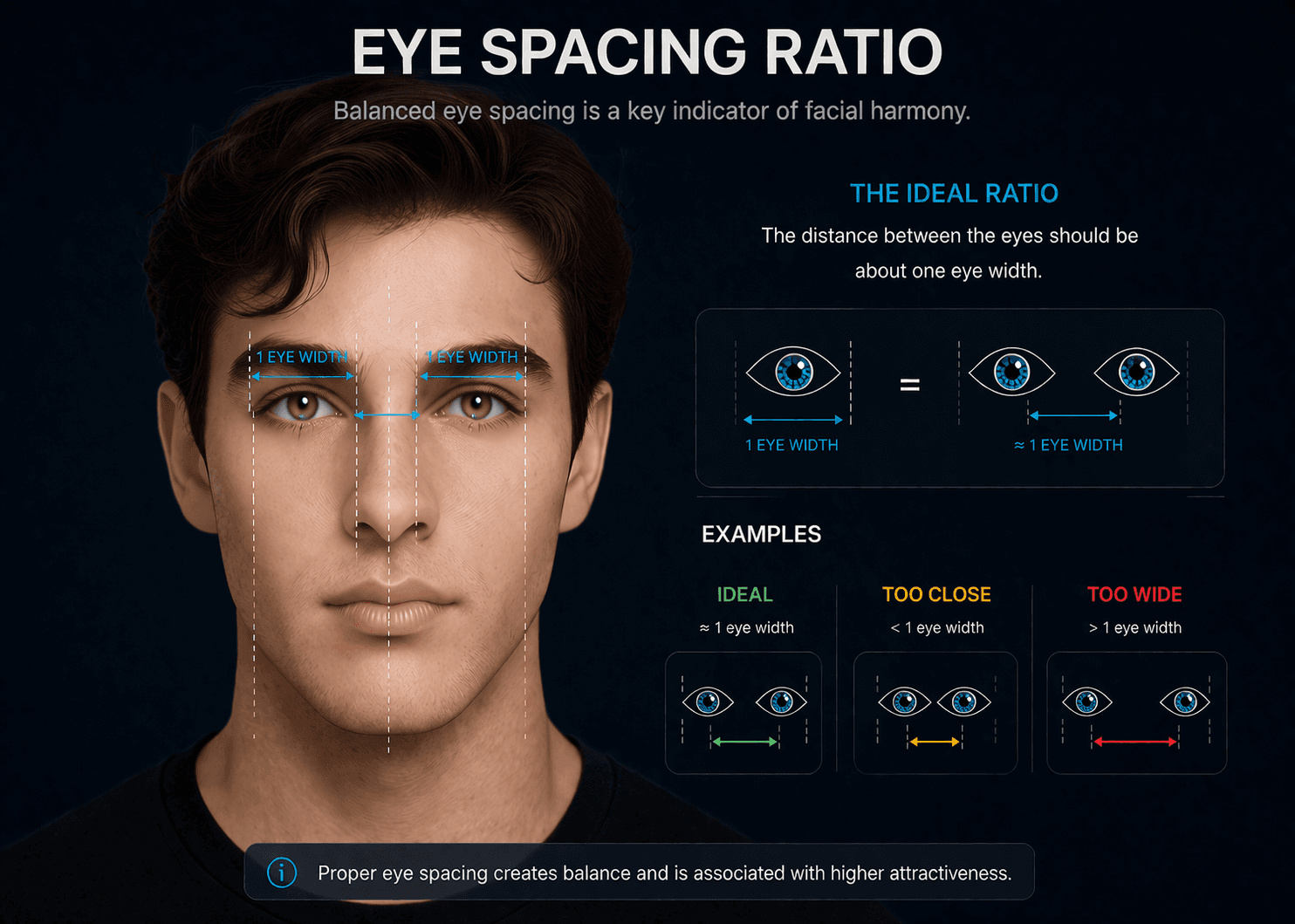
Balanced eye spacing is typically close to one eye-width apart
4. Cheekbones
- Cheek width
- Taper
- Midface prominence
Higher and more defined cheekbones often enhance midface structure.
5. Facial Proportions
- Facial thirds balance
- Vertical harmony
- Horizontal alignment
How Scoring Works#
- Landmark detection (478 facial points)
- Ratio and angle calculation
- Goal-aware category scoring
- Category-level synthesis and supporting consistency checks
- Structural and photo-quality safeguards before presentation
Our model is based on modern facial landmark detection systems used in computer vision research.
Category scores use smoothed reference ranges rather than treating one exact ratio as perfect. The overall score can also be limited when one or more visible areas do not support a higher result.
Scores between 75–84 indicate balanced structure. Scores of 85 or higher suggest strong harmony.
What Is a Good Face Score?#
Treat the range as an interpretation of this photo, not a permanent rating. Angle, expression, lighting, and lens distortion can change the visible measurements.
How Categories Contribute#
Jawline, symmetry, eyes, cheekbones, and proportions are evaluated as distinct categories. The selected masculine, feminine, or balanced goal changes how the category results are interpreted, but it does not move an observation into an unrelated category.
The overall score looks for agreement across the displayed categories. A single strong feature is not enough to make the whole face exceptional, and one uncertain cue should not erase an otherwise consistent result. This makes the breakdown easier to understand and reduces the influence of photo noise.
Exact coefficients, internal reference bands, calibration assets, and decision rules are proprietary. We publish the category meanings, photo-quality requirements, privacy behavior, and limitations so you can interpret the result without exposing a formula that can be copied or gamed.
How Accurate Is AI Face Analysis?#
- Lighting
- Camera angle
- Facial expression
- Lens distortion
- Image resolution
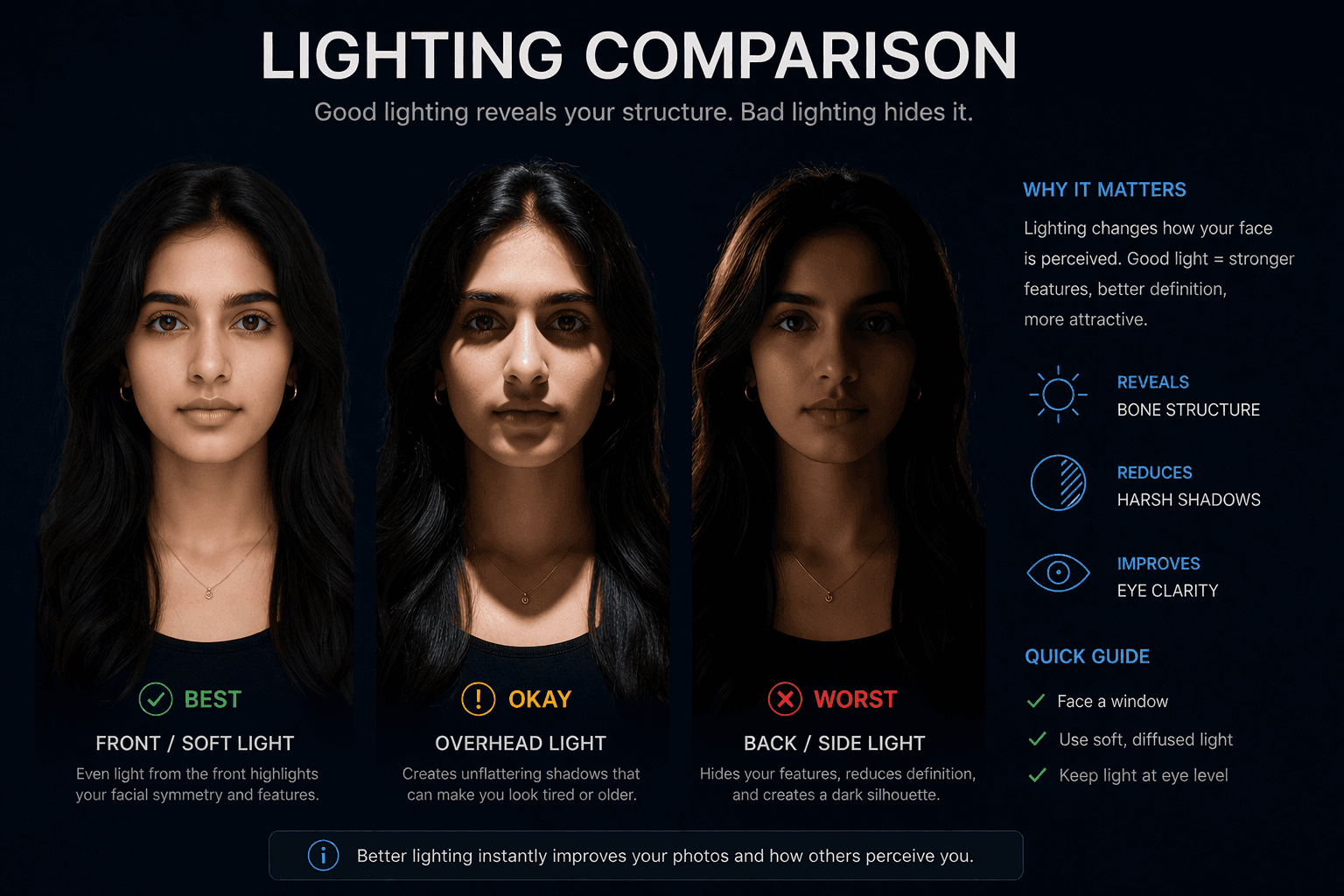
Good lighting (left) vs poor lighting (right) - natural window light works best
2D photo analysis cannot perfectly measure depth. For best results, use straight-on photos in natural lighting. When the system detects likely distortion or a non-standard face view, the displayed score may be capped and marked as lower confidence.
Best Practices for Accurate Results#
- Use natural window lighting
- Keep a neutral expression
- Face the camera directly
- Avoid wide-angle lens distortion
- Remove glasses
Frequently Asked Questions#
- What is considered a good face score?
- Scores between 75–84 are considered balanced. Scores of 85 or higher indicate strong facial harmony.
- Can I improve my face score?
- Presentation choices such as grooming, posture, hairstyle, and photography can change how facial harmony reads in a photo. Structural measurements are less changeable, so the score is best used as practical feedback rather than a target.
- Why did my score change between photos?
- Angle, lighting, lens distortion, and facial expression can affect landmark positions and visible ratio calculations.
- Do you store my photos?
- Core face analysis runs on your device without uploading your photo. Optional AI photo features send an image for processing only with your consent; some temporarily store an encrypted copy. See our Privacy Policy for processing and retention details.
Sources#
- MediaPipe Face Landmarker documentation
- Google Research: Real-time Facial Surface Geometry from Monocular Video
- PubMed (PMID: 41226978): Advanced 3D Facial Scanning in Orthodontics: A Correlative Analysis of Craniofacial Anthropometric Parameters