

Round opening
More visible vertical openness relative to corner-to-corner width.
Measure round, almond, or elongated opening geometry and a separate upturned, level, or downturned corner direction. Lid-fold appearance is available as an optional visual self-check rather than an automated claim.
Use a level front photo with both eyes relaxed and naturally open so their visible outlines can be compared.
Drag and drop your photo here
or choose a file below
JPG, PNG, WebP or HEIC · Up to 30 MB
Best results: eye-level camera, direct gaze, relaxed eyes, no glasses.
🔒 Private: core analysis stays on your device. Your photo is shared only if you separately opt in to an eligible AI photo feature.

Example framing only, not a target look.
For the best results:
Results are based on visible eyelid margins, eye corners, spacing, and bilateral agreement.
Need more details? See FAQ
The detector measures the visible opening of each eye from its inner and outer corners and upper and lower eyelid margins. Width is divided by perpendicular aperture height, so sideways image roll does not create a false opening shape.
Opening shape and corner orientation are reported independently. Lid-fold appearance is not inferred from landmarks; after the automatic result, you can optionally compare your relaxed eyes with the visual reference and add a self-reported description.
Trace
Map both visible eyelid margins and the inner and outer corners.
Measure
Calculate each width-to-height ratio and check bilateral agreement.
Describe
Combine the automatic measurements and optionally add your own visual lid-fold description.
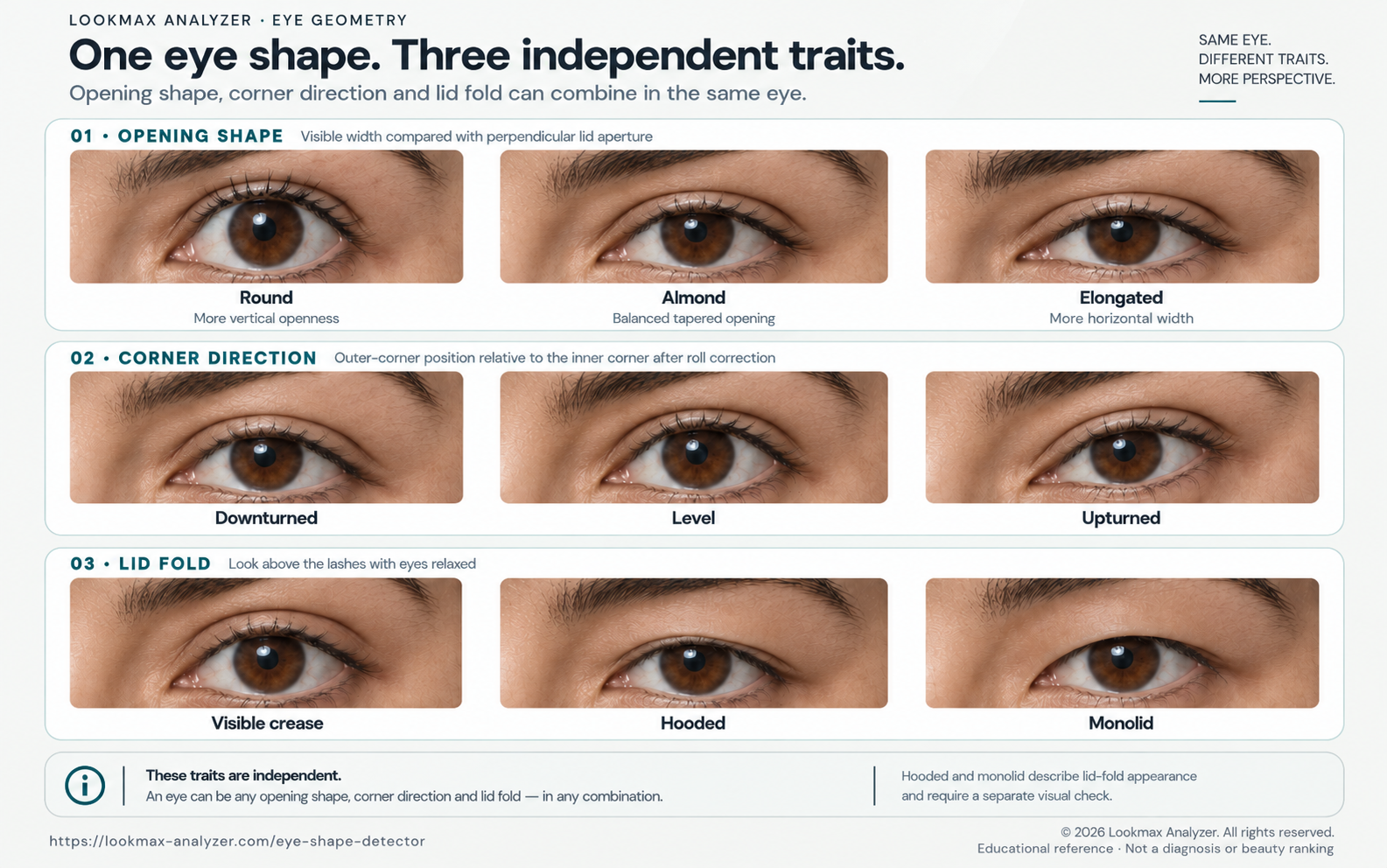
Attribution does not grant reuse rights. Read the image reuse terms.
More visible vertical openness relative to corner-to-corner width.
A balanced, tapered opening between the round and elongated bands.
More horizontal width relative to the visible upper-to-lower aperture.
The outer corner sits lower than the inner corner after roll correction.
The inner and outer corners sit near the same corrected horizontal level.
The outer corner sits higher than the inner corner after roll correction.
A distinct upper-lid crease remains visible above the lashes.
The upper-lid fold sits close to the lashes and reduces visible lid space.
No distinct crease is visible in the sampled upper-lid region.
The product bands use width divided by perpendicular lid aperture. They are transparent descriptive labels, not clinical norms or attractiveness targets. Results close to either boundary say so explicitly.
More visible vertical aperture relative to corner-to-corner width.
An opening proportion between the round and elongated bands.
More horizontal width relative to the visible lid aperture.
| Trait | Possible descriptions | Evidence | Tool status |
|---|---|---|---|
| Opening shape | Round · Almond · Elongated | Eye-corner width and perpendicular upper-to-lower lid aperture | Measured |
| Corner direction | Downturned · Approximately level · Upturned | Inner-to-outer corner angle after detected roll correction | Measured |
| Lid fold | Visible crease · Hooded · Monolid | Your visual comparison with relaxed eyes | Optional · self-reported |
Head turn lowers result confidence; genuinely unstable bilateral evidence produces a retake request without consuming the free result.
Core landmark analysis runs in your browser. Your photo is shared only if you explicitly opt into a separate AI styling preview.
The main label checks both eyes. It does not hide large left-right disagreement inside a simple average.
This is visible two-dimensional geometry from one photo—not a diagnosis, identity classifier, or attractiveness grade.
Eye shape is easier to describe on separate axes. The visible opening can be round, almond, or elongated, while the corner direction can be downturned, approximately level, or upturned. This detector measures both from a suitable front photo.
It traces the visible eyelid margins of both eyes, divides corner-to-corner width by perpendicular lid aperture, checks left-right agreement, and measures corner direction after detected head roll is corrected.
Yes. Almond describes the visible opening proportion, while upturned describes the corner direction. Because they are independent traits, they can appear together in one result.
No. Face landmarks trace the visible lid margins but not the upper-lid crease or overlying fold reliably. The result therefore offers an optional visual self-check for visible crease, hooded, monolid, or not sure instead of forcing an automated label.
Some bilateral difference is normal. Gaze, squinting, expression, head turn, lighting, glasses, or a partly hidden eyelid margin can also increase the difference in a photo. Strong disagreement produces a retake request rather than a forced label.
Makeup can change visual emphasis but not the underlying anatomy. Heavy liner, lashes, or shadow can also hide eyelid margins and make automated measurement less reliable.
No opening or corner-direction category is inherently better. The labels describe photographed geometry rather than attractiveness, health, ethnicity, identity, or personal value.
Result safeguards
Core landmark analysis happens in this browser.
Openings and corner directions are checked on both sides.
Pose lowers confidence; unstable bilateral evidence triggers a retake.
No beauty, health, ethnicity, or identity ranking.