

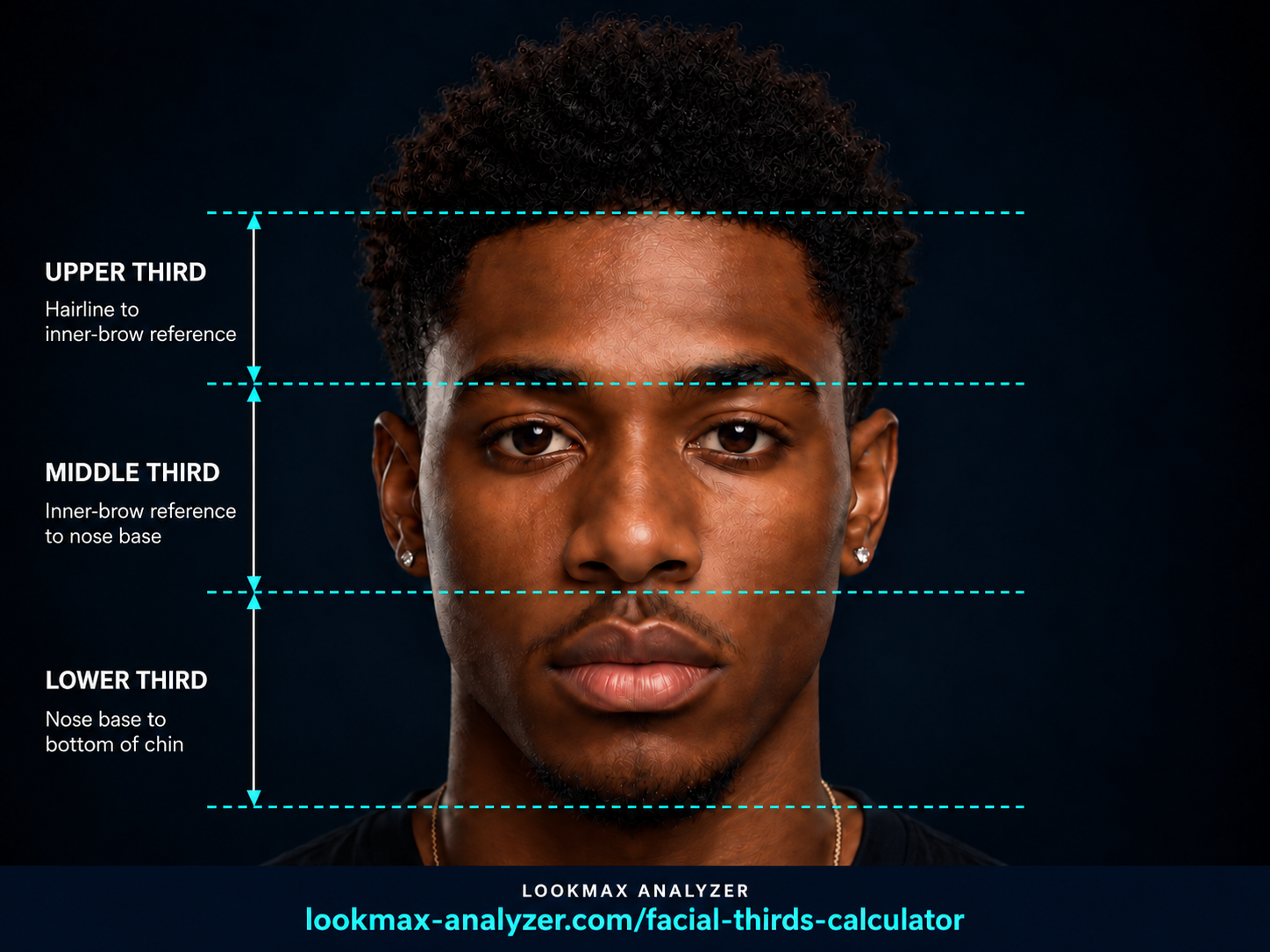
Upper third
Central visible hairline to the inner-brow reference.
Photo-based proportion tool
Measure your upper, middle, and lower face proportions. See three percentages and the boundaries on your photo, with an adjustable hairline guide.
Includes one of your two free specialized tool results. Previously revealed tools remain available in this browser.
Measure my facial thirdsChoose a level, front-facing photo with your hairline, brows, nose base, and chin visible.
Drag and drop your photo here
or choose a file below
JPG, PNG, WebP or HEIC · Up to 30 MB
Best results: hair pulled back, head level, even light, relaxed mouth.
🔒 Private: core analysis stays on your device. Your photo is shared only if you separately opt in to an eligible AI photo feature.

Example framing only, not a target look.
For the best results:
Percentages use hairline-to-chin height. An uncertain hairline is labeled as estimated.
Need more details? See FAQ
The calculator locates your inner-brow reference, nose base, and chin, then uses the same observed or estimated hairline as the facial-thirds report. It divides each section by total hairline-to-chin height and expresses the result as a percentage.
The photo guide shows all four boundaries. If the upper line misses a visible hairline, adjust it with the slider. This changes only the calculator preview; the middle-to-lower comparison stays the same.
Choose a photo
Face forward with a level head, relaxed mouth, and visible hairline.
Check the boundaries
Inspect hairline, inner brows, nose base, and chin on your photo.
Read your thirds
Compare the three percentages and their measurement confidence.
Attribution does not grant reuse rights. Read the image reuse terms.
Central visible hairline to the inner-brow reference.
Inner-brow reference to the base of the nose.
Base of the nose to the bottom of the chin.
Facial thirds divide the front of the face into three vertical sections. Four horizontal reference lines mark the hairline, brow area, base of the nose, and bottom of the chin.
Hairline → inner-brow reference
Forehead height
Inner-brow reference → nose base
Central vertical section
Nose base → bottom of chin
Lower-face height
These boundaries define the three sections. Your own photo may show different shares. The calculator uses the average height of two inner-brow landmarks as a reproducible brow reference; other measurement conventions can give different values.
For example, sections of 90, 100, and 110 pixels total 300 pixels. Their shares are 30%, 33.3%, and 36.7%. The middle-to-lower comparison is 100 ÷ 110, or 0.91.
The calculator rounds displayed percentages to total 100%, while using the underlying measurements for comparisons.
Equal thirds are an educational reference for vertical balance. This facial thirds test does not label unequal sections as unattractive or assign a beauty score. A forehead measurement, lower-face height, and chin projection also describe different things.
Read the percentages as a description of this photo. Small differences, measurement conventions, and uncertainty matter more than matching a single number exactly.
Read the facial thirds guide →Facial landmarks alone do not establish a true hairline. The analyzer uses visible image evidence when available; otherwise it models the upper boundary from proportions. Modeled, clamped, or uncertain boundaries make all three percentages approximate because they share the same total height.
The result lets you move the top guide to your visible hairline. This local adjustment leaves your saved report unchanged. If you cannot see the hairline, retake the photo; the middle-to-lower comparison can still describe the two lower sections independently.
Keep your head level and camera near eye height. Head turn, close camera perspective, a raised or tucked chin, a broad smile, and an open mouth can distort vertical proportions.
They are the upper face from hairline to brow reference, the middle face from brow reference to nose base, and the lower face from nose base to chin. Each is expressed as a share of their combined height.
The analyzer uses facial landmarks and an observed or estimated hairline to calculate three vertical shares. Its brow reference is the average height of the two inner-brow landmarks. You can adjust the hairline guide locally if it differs from the visible boundary.
Equal thirds, or 1:1:1, are a classical proportion reference. They are not a universal beauty requirement. This test reports measurements rather than giving a pass/fail or attractiveness score.
A hidden hairline cannot be measured confidently. When the observed boundary is unavailable or uncertain, the upper boundary is estimated and the percentages are labeled approximate. Use a photo with your hair pulled back, then adjust the guide to the visible hairline if needed.
No. Facial thirds compare three vertical sections with equal division. Our golden ratio tool compares hairline-to-chin height with cheekbone width and the constant 1.618. They answer different measurement questions.
Core facial landmark and thirds calculation runs in your browser. Model assets may be downloaded, and the current analysis may be stored locally to restore your result. Separate paid services have their own disclosures.
An eligible thirds result, including percentages and the photo guide, counts as one of your two free specialized tool results. Previously revealed tools remain available in the same browser. The complete face report is offered separately.
Facial thirds compare vertical sections. The Golden Ratio Face Calculator compares face height with width and 1.618. The Facial Ratios Calculator covers twelve relationships, including thirds, eye spacing, nose width, and midface balance.