

1
Eyes
Eye level, visible size, openness, and tilt agreement.
Free · no signup · private in-browser
Upload one level, front-facing photo to check left-right balance across your eyes, brows, nose, mouth, chin, and jaw.
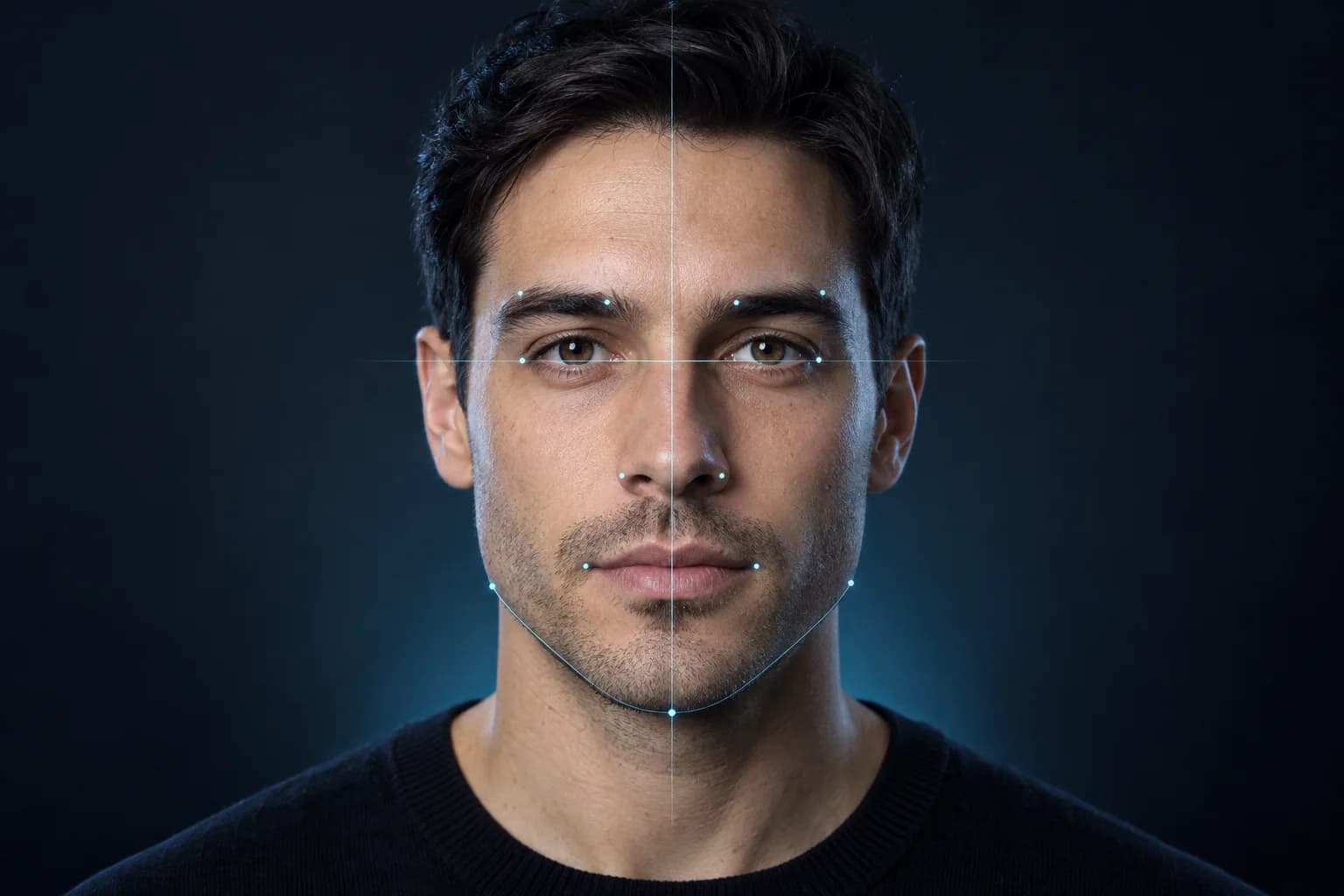
Try it now
Use a relaxed, closed-mouth expression with both eyes, brows, cheeks, and the full jawline visible.
Private symmetry scan
Use a straight front-facing photo so left-right alignment is easier to read.
Quick private upload. Symmetry analysis starts after the next step.
Best results: centered face, level head, even lighting.
🔒 Private: core analysis stays on your device. Your photo is shared only if you separately opt in to an eligible AI photo feature.

Example framing only, not a target look.
For the best results:
Results are based on facial alignment, centerline balance, and symmetry.
Need more details? See FAQ
The test focuses only on bilateral balance. It compares several independent regions so one raised brow or uneven shadow does not define the whole category by itself.
Use a level, front-facing photo with a neutral expression. Head turn and close-lens perspective can make one side appear larger even when the underlying face has not changed.
Align
Use a centered photo with the camera at eye level.
Compare
The analyzer checks upper-, middle-, and lower-face agreement.
Interpret
Read the score with photo confidence and the strongest mismatch cue.
Multi-region comparison
The analyzer evaluates 500+ facial data points and compares independent left-right cues. Corroboration across regions matters more than one isolated mismatch.
Symmetry is context-invariant: changing the selected presentation goal does not change the detected geometry or the category reference.
Eye level, visible size, openness, and tilt agreement.
Left-right brow position when eye openness is reliable.
Visible deviation from the estimated facial centerline.
The angle between the visible left and right mouth corners.
Chin-center, contour, width, and jaw-corner agreement.
Missing or unreliable evidence should add uncertainty, not be treated as perfect agreement. The final score remains an estimate from one 2D image.
Full methodologyControl the capture
A camera turns a three-dimensional face into a flat image. Before treating a lower score as structural, remove the four most common sources of false asymmetry.
Makes the nearer side look wider and the farther side look compressed.
Keep both ears and both cheek boundaries comparably visible.
Moves one eye, brow, and jaw corner higher in the frame.
Keep the eye line level and the camera at eye height.
Magnifies the center and exaggerates small distance differences.
Move farther away and crop afterward instead of using a close selfie.
A raised brow, half-smile, squint, or side shadow can mimic imbalance.
Use a relaxed closed-mouth expression and even frontal light.
Interpretation guide
Read the number as a summary of visible agreement in this photo—not as proof that both sides should be identical.
The score compresses several left-right measurements from one photo into a simpler readout.
Natural faces are not mirror copies. A small difference is expected and may be hard to notice in motion.
Symmetry is one category. It does not replace jawline, eyes, cheekbones, proportions, expression, or style.
Retest only with similar camera distance, lighting, expression, and head position.
Copying one side and reflecting it creates two artificial faces. It can reveal differences, but it also duplicates expression, lighting, and lens distortion from that side. This test instead compares multiple landmark pairs in the original photo.
Facial symmetry describes how closely paired features align around the face's estimated vertical centerline. It includes position, size, angle, and contour—not whether the two sides are exact copies.
Real faces contain natural variation. The useful question is whether several independent regions show a consistent difference in a reliable photo.
Read the facial symmetry guideSymmetry can contribute to a balanced first impression, but it is only one category. Strong proportions, eye area, cheekbone framing, jawline, expression, and presentation can coexist with visible asymmetry.
The symmetry score is not a health assessment, diagnosis, or complete attractiveness rating.
Common questions
The test detects visible facial landmarks, establishes a facial centerline, and compares left-right differences across the eyes, brows, nose, mouth, chin, and jaw. The measurements are combined into one photo-based symmetry score.
Yes. The free result includes your symmetry score and three available regional checks: eyes, brows and nose, with photo measurement guides and explanations. Mouth and jaw balance checks are included in the optional paid report, alongside additional facial categories and personalized priorities.
The core symmetry analysis runs in your browser, so the photo stays on your device for that scan. It is shared only if you later opt in to an eligible AI photo feature.
Some left-right difference is normal in virtually every face. Eye height, brow position, mouth angle, and jaw contour rarely match perfectly, and a small measured difference is not automatically noticeable in daily life.
It can describe visible landmark alignment in a suitable front photo, but it cannot fully separate three-dimensional structure from perspective. Head turn, lens distance, expression, lighting, hair coverage, and landmark visibility can all affect the result.
You are familiar with your reversed mirror image, while an ordinary photo shows the opposite orientation. Close selfie lenses, slight head turn, uneven light, and facial expression can also exaggerate left-right differences.
No. Symmetry is one visible component of facial harmony, not a complete attractiveness judgment. Proportions, feature shape, expression, styling, and individual preference also affect how a face is perceived.
Perceived balance can change with a straighter photo setup, posture, hairstyle, brow grooming, facial-hair grooming, makeup, or treatment of temporary swelling. A photo score cannot determine whether a structural, dental, or medical treatment is appropriate.
No. The detected left-right differences do not change with a masculine, feminine, or balanced presentation goal, so the symmetry category uses the same reference across contexts.