
+
Positive tilt
The outer eye corner sits higher than the inner eye corner.
Upload one level, front-facing photo to measure both eyes and see the average angle in degrees—positive, neutral, or negative.
Use a level, front-facing photo so the inner and outer eye corners can be compared.
Drag and drop your photo here
or choose a file below
JPG, PNG, WebP or HEIC · Up to 30 MB
Best results: level head, relaxed eyes, even lighting, camera at eye height.
🔒 Private: analysis stays on your device. Your photo is shared only if you later opt in to an AI styling preview.

Example framing only, not a target look.
For the best results:
Results are based on detected inner and outer eye-corner landmarks.
Need more details? See FAQ
The calculator locates the inner and outer corners of both eyes. It measures the upward or downward angle of each eye and averages the two values into one canthal tilt result.
Before measuring, the analysis corrects detected sideways head roll. A centered, eye-level photo is still important because head yaw, camera position, expression, and partially hidden eye corners can change the estimate.
Align
Use a centered photo with your head level and both eye corners visible.
Measure
The calculator compares inner and outer eye-corner landmarks on both sides.
Interpret
See the average angle in degrees and its positive, neutral, or negative direction.
Canthal tilt direction describes whether the outer eye corners appear above, approximately level with, or below the inner corners.
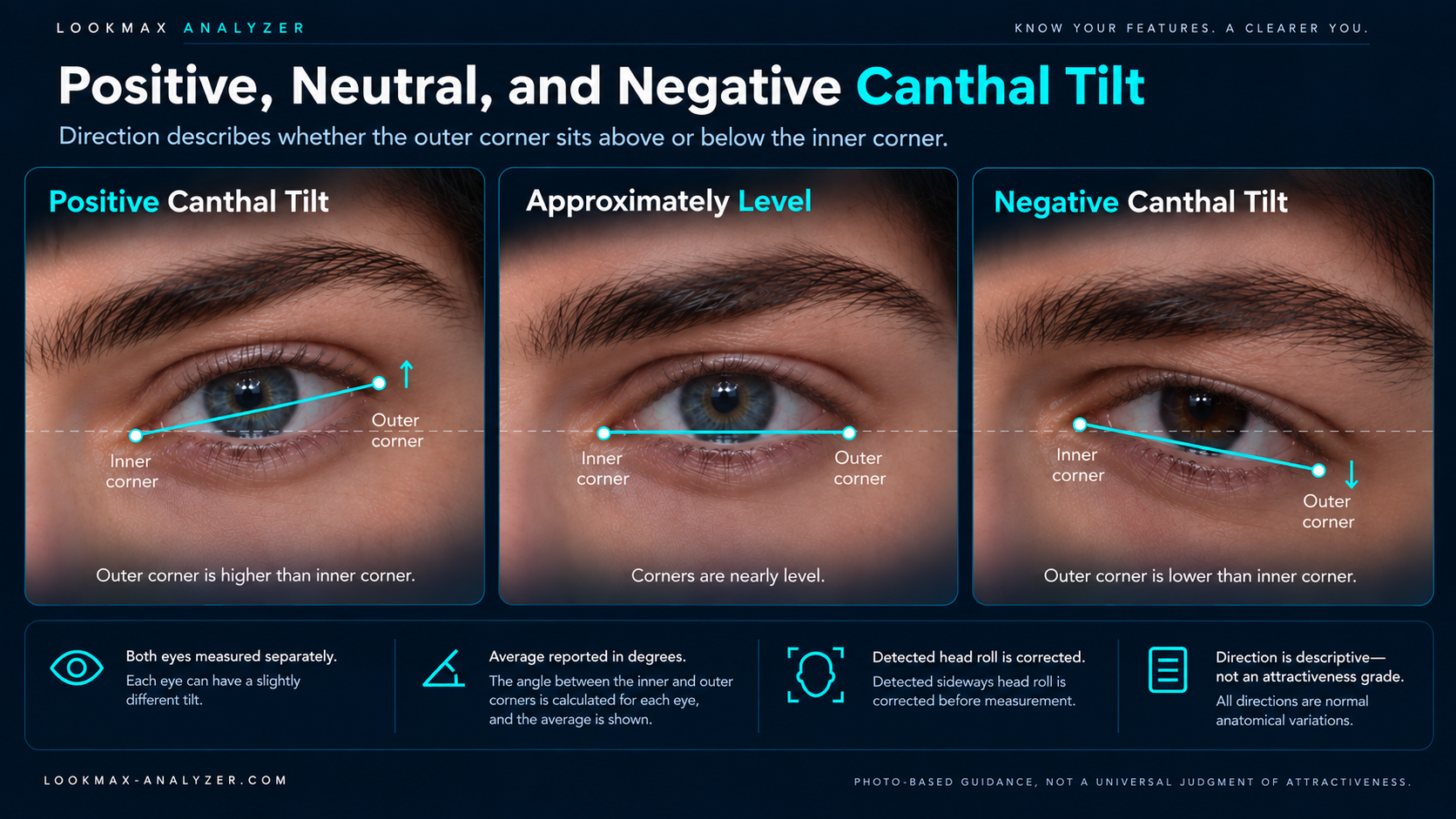
The outer eye corner sits higher than the inner eye corner.
The inner and outer eye corners sit close to level.
The outer eye corner sits lower than the inner eye corner.
Direction is descriptive—not an attractiveness grade. Values close to level can move slightly with landmarks and photo setup.
Read the average angle together with the direction and photo quality. This is a geometric eye-corner calculation—not an eye-area score or percentile.
Primary result
Average canthal tilt in degrees
Each eye is measured separately after detected sideways head roll is corrected. The two values are then averaged and displayed to one decimal place.
The calculator corrects detected sideways head roll, but it cannot fully remove perspective, expression, or hidden-landmark errors from the source photo.
| Photo factor | Possible effect | Better setup |
|---|---|---|
| Camera height | Looking up or down changes the apparent eye-corner slope. | Keep the lens close to eye level. |
| Head turn | A three-quarter view compresses one eye and shifts its landmarks. | Face straight ahead with both sides equally visible. |
| Expression | Squinting or raised brows can move visible eyelid and corner cues. | Use relaxed eyes and a neutral expression. |
| Light and occlusion | Shadow, hair, or glasses can hide an inner or outer corner. | Use even light and keep both eye corners unobstructed. |
For comparisons over time, repeat the same camera distance, lighting, and expression. Read the full face-photo guide.
Canthal tilt describes one direction. Eyelid exposure, eye shape, spacing, brow position, under-eye support, bilateral balance, and expression are separate signals.
A positive angle does not guarantee attractiveness, and a neutral or negative angle does not make a face unattractive. Use the value as one measurement rather than a verdict.
This is a two-dimensional landmark estimate. It cannot fully measure facial depth or guarantee that a different photo will return the identical angle.
Core landmark analysis runs in your browser. Your photo is shared only if you explicitly opt into a separate AI styling preview.
The result is not a medical diagnosis, population percentile, or attractiveness ranking.
Canthal tilt is the angle from the inner corner of an eye to its outer corner. A positive tilt means the outer corner sits higher, a neutral tilt is close to level, and a negative tilt means the outer corner sits lower.
The calculator detects the inner and outer corners of both eyes, corrects detected head roll, measures each eye angle, and reports their average in degrees.
A positive canthal tilt means the outer eye corner sits higher than the inner eye corner. The number of degrees describes the size of that upward angle.
Yes. Head angle, camera height, lens distortion, squinting, expression, hair, and shadows around the eye corners can all affect a photo-based measurement.