

Five Facial Features and Photo Presentation: What They Can Explain
Published Updated 6 min read
A photograph can be described in several ways: how its two sides line up, how features relate in size, what the jaw and cheek contours look like, and how the image was captured. This guide discusses five such topics. Their order is editorial; it is not a research-backed ranking of the five most important determinants of attractiveness.
Use it to turn a broad question such as "What stands out in my face?" into a more specific one: Are the two sides being photographed evenly? Which distances are being compared? Is an apparent contour coming from shape, expression, or light? Those questions give you something concrete to inspect alongside a result.
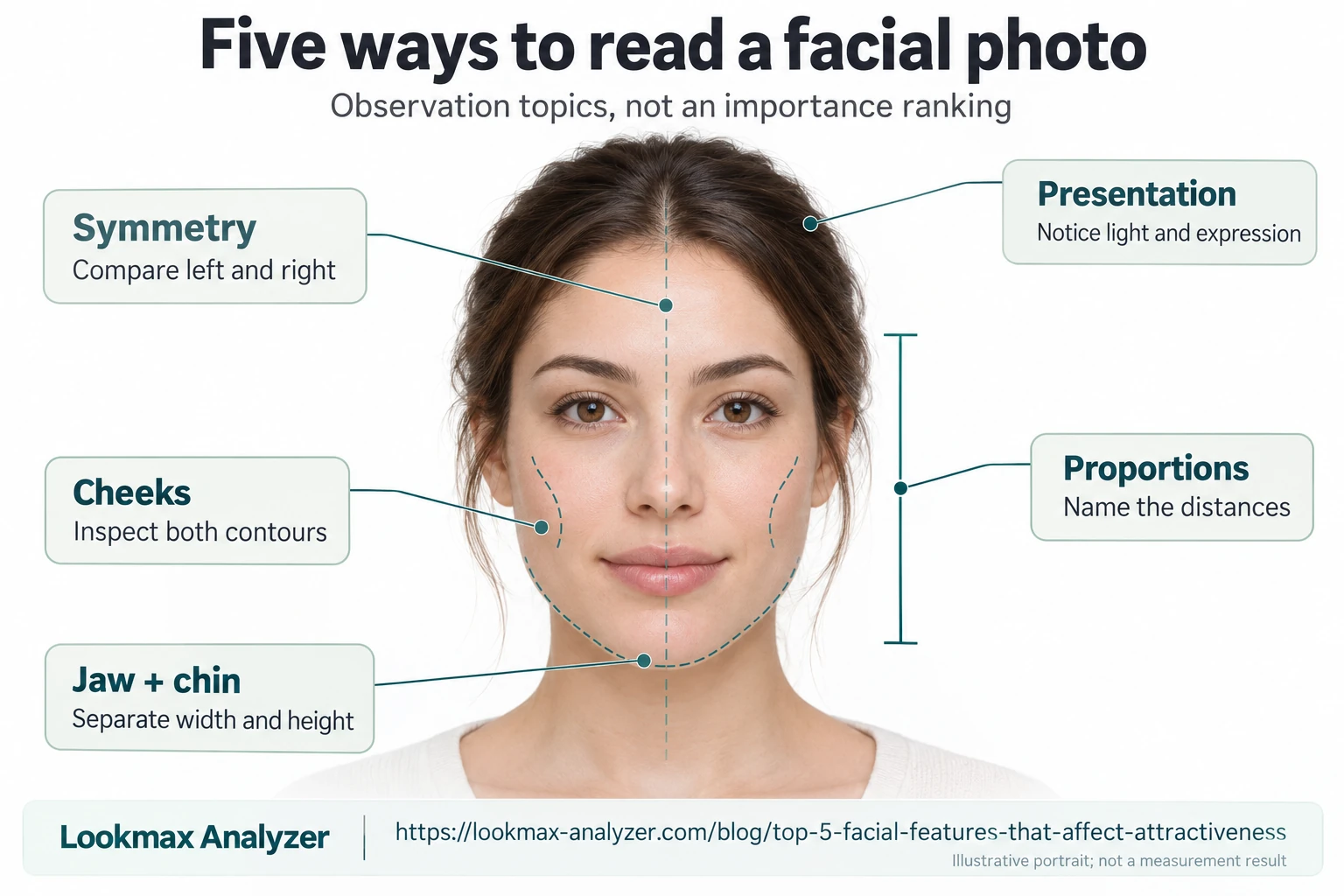
Attribution does not grant reuse rights. Read the image reuse terms.
Read the illustration description
Compare observations
The centerline suggests comparing the two sides. The bracket reminds readers to define the distances in a proportion. Neither is a measurement result.
Read contours separately
Jaw and chin width and height are separate observations. The cheek marks identify visible contours, not underlying bone depth.
Keep the photograph in view
Presentation includes light and expression. These five editorial topics are not an importance ranking or the app’s five structural scoring categories.
Five Topics to Understand in a Facial Photograph#
1. Symmetry
Symmetry describes left/right differences. A head turn, blink, or tilted camera can affect what those differences look like in a photograph. The symmetry guide explains how to read this category alongside the image.
In Foo and colleagues' 2017 study, associations between measured traits and attractiveness ratings differed between male and female faces. Symmetry was one predictor in the male sample. The study does not establish a universal ranking or show that a selfie symmetry score diagnoses health.
What to look at: separate the position of a feature from its size and shape. One eye can appear higher while the openings look similar; two level eyes can have different visible openings. A brow difference is another observation again. Describing the specific difference is more useful than labeling the entire face "asymmetrical."
Before comparing sides, check whether both cheeks and both sides of the nose are similarly visible. If one side is turned away, a fresh front-facing capture is a better starting point. If a difference remains visible, record the region rather than assuming every other feature shares it.
2. Proportions
Ratios describe relationships between visible distances, such as facial thirds or eye spacing. A ratio needs a clear definition and denominator before two readings can be compared. The facial ratios tool and proportions guide explain those relationships. An app's preferred band is a modeling choice, not a universal requirement for an attractive face.
What to look at: read the endpoints before reading the number. "Chin height relative to face width" and "chin height as a share of the lower face" use different denominators. The same chin can therefore have different numerical descriptions without either calculation being contradictory.
Facial thirds need similar care. Their percentages share one total and add to 100%, so changing the estimated hairline can change all three percentages. Check the hairline reference before interpreting a longer-looking upper third as a structural difference.
3. Jaw and chin appearance
Width, chin shape, and the visible lower-face outline are different observations. They can point in different directions within one photo. This article does not claim that a sharper jaw is always preferable or that it outweighs all other features. Read the jawline guide for interpretation and front-photo limits.
What to look at: distinguish the width across the jaw, the vertical height of the chin, and the slope of the visible jaw border. A broad outline does not necessarily imply a tall chin, and a sharply lit border does not tell you its underlying dimensions.
A front-facing photograph and a side photograph also answer different questions. Use the side-profile tool if your question concerns the profile relationship between the nose, lips, and chin. Treat that as a separate view rather than trying to infer a full side profile from a frontal outline.
4. Cheek appearance
Cheek width, lower-cheek contour, and apparent height describe different aspects of the midface. Lighting and expression complicate their interpretation. A shadow is not a measurement of underlying bone projection. The cheekbone guide separates these observations.
What to look at: identify whether you mean a wide midface, a high-looking contour, or a hollow-looking area below it. These descriptions are often bundled together as "strong cheekbones," but they refer to different visible relationships. Look at both sides in even light before relying on one pronounced shadow.
For a useful comparison, keep the expression similar. Comparing a relaxed photograph with a broad smile asks two questions at once: how the face is shaped and how it is being posed. Note the expression difference before drawing a conclusion about the cheek area.
5. Skin appearance and photo presentation
A photograph also records surface appearance, hair, grooming, expression, and lighting. Those observations extend beyond facial geometry. Jenkins and colleagues' 2011 experiments found substantial variation across photographs of the same people, including attractiveness judgments. This supports caution about treating one photograph as a complete account of someone's appearance; it does not validate a skin score or predict a benefit from a particular skincare routine.
What to look at: decide whether you are comparing appearance or capture quality. A bright highlight, a dark under-eye shadow, and visible texture are different observations. If you are testing a new hairstyle, keep the camera and light similar and compare the framing around the face. If you are testing the capture setup, keep the styling similar instead.
Write down what you prefer in the image: "I like the hair away from my eyes" is a clear personal judgment. A higher app score is not required to justify that preference.
What Can the Research Establish?#
A study's result depends on its participants, images, rating task, and analysis. Hönekopp's 2006 experiments found substantial contributions from both shared and individual taste. They do not provide weights for this five-topic list or establish one ideal appearance for every observer.
We therefore do not claim that jawline and proportions have the largest effect for everyone, that symmetry always comes next, or that our list is exhaustive. Eyes are also a category in the app's structural analysis even though this editorial overview groups its topics differently.
Read the Whole Photograph#
Consider which observation you are trying to understand. A changed cheek shadow, a different expression, and a changed measurement are not interchangeable explanations. Compare the submitted images before interpreting a small score difference as a change in facial structure.
For example, a relaxed capture and a smiling capture can show different eye openings and cheek outlines. This is an illustrative comparison, not a measured case study or a promise that one expression produces a better score. Use the photo setup guide to keep comparisons more consistent.
Different observations can also coexist. A face can have similar vertical thirds and a relatively short chin within the lower third. It can have a broad jaw outline and a visible left/right difference. Reading each description separately avoids treating one favorable measurement as an answer to every question about the face.
A Worked Example: Why the Denominator Matters#
Imagine a drawn face with a chin segment measuring 30 units and a lower-face segment measuring 90 units. The chin's share of that segment is 30 ÷ 90, or about 33%. If a second drawing keeps the chin at 30 units but extends the lower face to 100 units, the share becomes 30%.
The chin did not become shorter in this example; the reference distance became longer. These are invented drawing measurements, not anatomical reference values or Lookmax Analyzer scoring thresholds. They illustrate why a percentage needs its definition beside it.
When comparing a ratio between two reports, check three things: the same endpoints, the same denominator, and a comparable capture. If one tool measures a lower-face share and another normalizes against face width, place them in separate rows rather than deciding which number is "correct" from its size alone.
Perception and the App Score Are Different Questions#
Lookmax Analyzer's five structural categories are Jawline, Symmetry, Eyes, Cheekbones, and Proportions. This article's five topics are not those five scoring inputs.
The separate Skin score is not added to the five structural categories or the structural total. The displayed result can also reflect photo-quality safeguards and an eligible apparent-age presentation adjustment. These product rules are not proof of a universal attractiveness formula. The methodology explains the public scope and limits.
A low category result identifies a model output for that photo and selected profile. It does not establish that people dislike that feature, that you have a medical problem, or that a treatment is needed.
Using Your Own Result#
Start with the submitted photo and its confidence information. Check whether a visible expression, obstruction, or capture problem makes the result difficult to interpret. The free preview includes a face score and strongest supported signal; the optional paid report adds category detail and explanations. Completion time depends on the device and model loading.
To make the result useful, work through it in this order:
- Choose one question. For example, "Does this photo show both sides evenly?" or "Which reference is used for this ratio?"
- Check the input. Look for a blink, hidden hairline, head turn, or cropped outline before interpreting a measurement.
- Read the relevant explanation. If you have category detail, inspect that category instead of asking the total to explain every feature.
- Keep a short observation. Record the photo setup, the reading, and anything uncertain. A note such as "jaw edge hidden by beard" is more informative than a bare score.
- Choose a proportionate next step. Retake an unsuitable photo, read the measurement definition, or compare a styling choice on its own terms. A model output alone is not a treatment plan.
You can finish with a useful description even when no single score settles the question: "The vertical ratios are similar across these captures, but the cheek outline is harder to inspect in the side-lit image." That separates what you can see from what you still need to check.
View the Free Face Analysis PreviewCommon Questions#
- What facial feature matters most?
- This guide does not establish a universal ranking. A finding from one sample or rating task does not show which feature matters most to every viewer.
- Is symmetry the most important facial feature?
- The cited research does not establish symmetry as a universal first-place feature. It is one of the measurements discussed here.
- Can you improve your facial features?
- Hairstyle, grooming, expression, and capture setup can change the appearance of a photo. That does not establish a change in anatomy or predict how everyone will rate it.
- Do AI tools really measure attractiveness?
- Lookmax Analyzer summarizes selected photo measurements using its own model. Its score is not a population percentile, a diagnosis, or a direct measurement of every viewer's preferences.
Sources and Scope#
- Foo et al., 2017: Predictors of facial attractiveness and health in humans — a study of particular traits and samples, not a ranking of this guide's five topics.
- Hönekopp, 2006: Private and shared taste in facial-attractiveness judgments — observer differences, not app-score calibration.
- Jenkins et al., 2011: Variability in photos of the same face — variation across photographs, not validation of Lookmax Analyzer.
- Lookmax Analyzer methodology — the product's explanation of its own model and limitations.
Updated October 20, 2026: Added feature-reading examples, a worked ratio explanation, and a practical result-reading sequence. Clarified the distinction between perception research and the app's structural categories. Sources checked on this date.