
Eye Area Explained: A Guide to Facial Harmony
4 min read
By Lookmax Analyzer Team — Mar 27, 2026
Eye Area Explained: A Guide to Facial Harmony
Whether you're curious about your eye area or want to understand how it's evaluated, this guide covers three core proportions: visible eye opening, eye spacing, and eyebrow height. You'll also see how measured structure differs from visual impression in photos and daily life.
What Is the Eye Area?#
The eye area includes the eyes themselves, eyebrows, and the surrounding region. It's one of the most expressive parts of the face and significantly impacts first impressions in photos and face-to-face interaction.
If you have seen the phrase
hunter eyes
, the useful underlying ideas are eyelid exposure, brow support, canthal tilt, and how the eye area fits the rest of the face—not the slang label itself.
Lookmax Analyzer evaluates three core eye-area proportions:
Visible Eye Opening — eye opening aspect ratio (horizontal fissure length vs vertical lid aperture)
Eye Spacing — distance between medial canthi relative to eye width and upper-face width
Eyebrow Height — vertical distance from upper eyelid margin to inferior brow border
Three Core Eye-Area Proportions#
In many aesthetic frameworks, these three proportions influence how balanced the eye area appears:
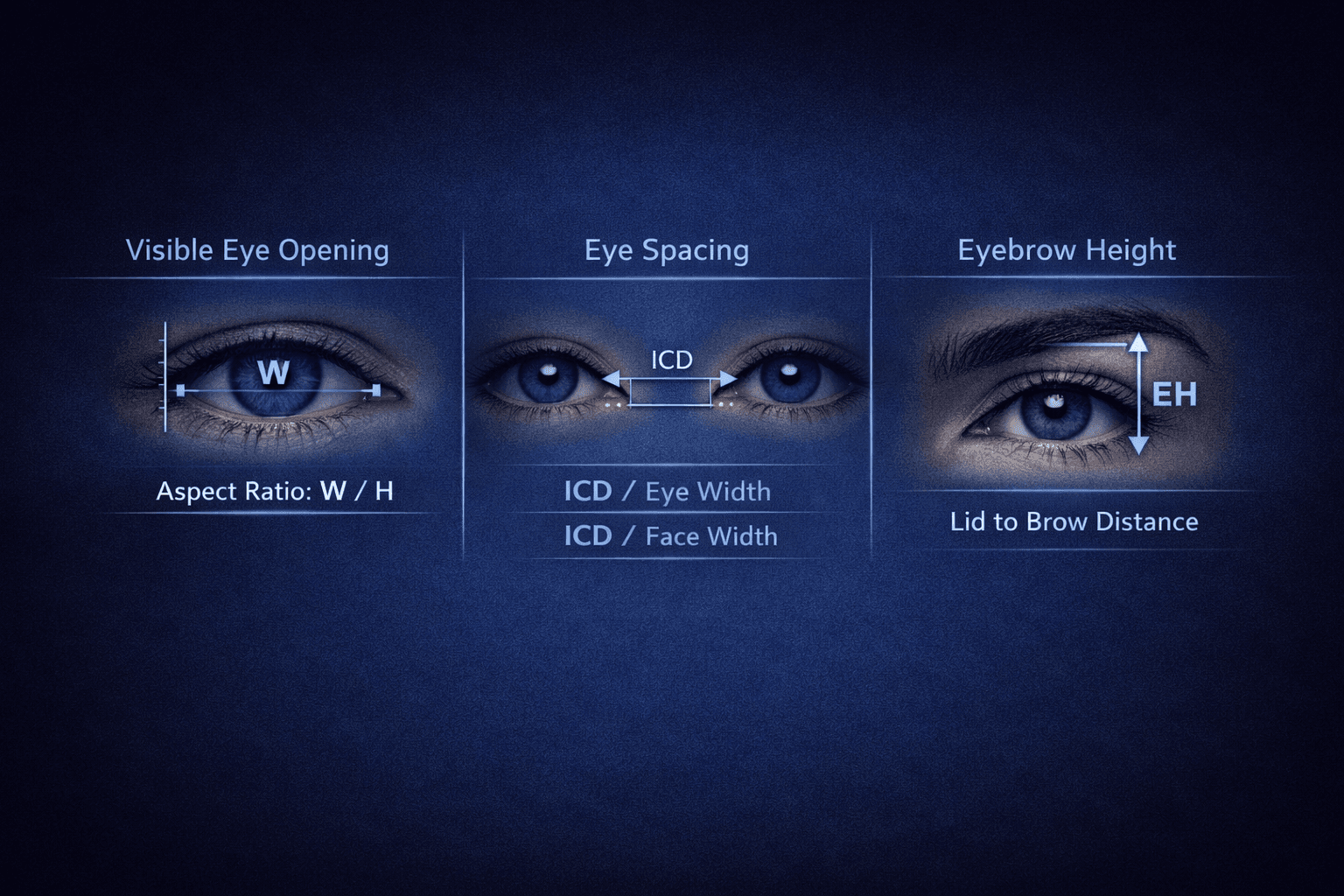
The three key eye-area metrics analyzed by Lookmax Analyzer
Visible Eye Opening
This reflects how open the eyes appear in a neutral expression. The analyzer uses a width-to-height relation of the visible eye aperture rather than a broad "big vs small eyes" label.
Eye Spacing
Spacing influences upper-face balance and visual rhythm. In many frameworks, an interocular distance around one eye width reads as balanced, with normal variation across individuals.
Eyebrow Height
Brow height affects framing, contrast, and perceived alertness. The same eye spacing can look very different when brows sit lower, higher, flatter, or more arched.
These proportions are guidelines, not rules. Overall facial harmony matters more than any single measurement.
Our analyzer compares your measurements to internal reference ranges used in aesthetic analysis. These aren't universal beauty rules — they are benchmarks for consistent feedback.
Why Eyes Matter for Attractiveness#
Focal Point of the Face
The eye area naturally attracts attention in conversation and photos, so small proportional changes here can shift overall facial impression more than expected.
Contrast and Framing
Brows, lashes, lid contour, and under-eye shadows create local contrast around the eyes. Stronger, cleaner framing often improves clarity and perceived harmony.
Expressiveness and Midface Harmony
Eye aperture and brow position affect how easily expressions read. They also interact with midface structure, so balance is assessed as a system, not as isolated features.
The goal isn't extreme eye openness or perfectly symmetrical eyebrows — it's overall balance that complements your unique facial structure.
How Lookmax Analyzer Evaluates Eye Area#
Our AI analyzes your eye area using three measured proportions:
Visible Eye Opening — horizontal fissure length and vertical lid aperture measured at the pupil centerline
Eye Spacing — medial canthus to medial canthus distance, normalized to eye width and upper-face width
Eyebrow Height — vertical distance from upper eyelid margin to the inferior edge of the brow, sampled near the pupil centerline
Recommended Photo Setup
Camera level — lens aligned to eye height, with head facing forward
Focal length — use roughly 50-85mm full-frame equivalent to reduce distortion
Lighting — even front lighting, minimal side shadow under brow or lower lid
Expression — neutral face, eyes naturally open, no squinting or raised brows
Landmarks and Reliability Notes
Core landmarks include inner and outer canthi, upper and lower visible lid margins, pupil center, and the lower eyebrow border. Eyebrow height is measured as a vertical eye-to-brow distance and normalized against local eye dimensions for consistency across face sizes.
Landmark notes: canthi are the inner and outer eye corners; lid margins are the visible upper and lower eyelid edges.
Apparent eye size can shift with lighting, camera angle, focal length, and expression. Mild head pitch or smile-induced squint can reduce measured openness even when anatomy has not changed.
Each metric is scored against reference ranges for your chosen goal (masculine, feminine, or balanced) on a 0–100 scale.
Visible eye opening and eyebrow height typically have more weight in scoring. Eye spacing importance depends on your chosen aesthetic goal.
Enhancing Your Eye Area#
1. Eyebrow Shaping
Well-groomed eyebrows that complement your eye shape can dramatically improve appearance. Consider professional shaping to find your ideal brow shape.
2. Eye Makeup
Makeup techniques like eyeliner, mascara, and eyeshadow can enhance eye appearance. These effects are temporary but can significantly impact your look.
3. Skincare
Healthy skin around the eyes enhances their appearance. Good skincare, sleep, and hydration help reduce signs of tiredness.
4. Eyelash Enhancement
Longer, fuller eyelashes can make eyes appear larger and more expressive. Options include mascara, lash extensions, and growth serums (which require consistent use).
5. Photography Tips
How you position yourself affects how your eyes appear in photos:
Direct eye contact — looking at the camera creates connection
Slight upward angle — can make eyes appear larger
Even lighting — reduces shadows under eyes
These approaches enhance your existing features — they won't change your bone structure or eye proportions, but can optimize how your eyes appear in everyday life and photos.
Measured vs Perceived Eye Area#
A landmark-based measurement and visual impression are related but not identical. The analyzer reports measured structure, while daily appearance is strongly influenced by presentation factors.
Makeup — liner placement and shadow gradients can increase perceived eye opening
Lashes — curl, density, and length affect apparent openness and contrast
Brow grooming — shape and cleanup alter framing and perceived brow height
Camera angle — pitch/yaw can change perceived spacing and eyelid show
Fatigue and swelling — temporary puffiness can change the eye area visually
Perception modifiers can change how the eye area reads without changing underlying anatomy.
Frequently Asked Questions#
- Can eye-area structure be changed?
- Underlying eye-area structure is largely determined by genetics and anatomy. Makeup, lashes, grooming, lighting, and camera setup can change perceived eye openness, but they do not change baseline structure.
- Does eyebrow shape affect eye-area attractiveness?
- Yes. Well-groomed eyebrows that complement your eye shape and face structure can significantly enhance attractiveness. The ideal shape varies based on individual features.
- What is ideal eye spacing?
- In many frameworks, interocular distance near one eye width is considered balanced. Practical assessment also checks how spacing interacts with brow framing and midface proportions.
- What eye area score is considered good?
- Our analyzer uses internal reference ranges. Higher scores reflect proportions that align well with your chosen aesthetic goal. Scores are relative to the selected framework, not absolute standards.
- Why does my eye area look different in photos?
- Camera angle, lens distortion, lighting, and whether you're looking directly at the camera all affect how eyes appear. Front-facing photos with even lighting show eye proportions most accurately.
Sources#
- American Academy of Ophthalmology: Eye anatomy overview
- PubMed (PMID: 41735422): Principal component analysis of 3-dimensional facial soft-tissue morphology in three adult populations
- PubMed (PMID: 22096491): Facial attractiveness ratings from video-clips and static images tell the same story
Ready to Analyze Your Eye Area?
Get your eye area score and personalized tips based on your facial features.