

Jawline Analysis: Understanding Your Photo Results
Published Updated 2 min read
Your jawline can look sharp in one photo and softer in another. This guide helps you understand a jawline analysis, read the chin alongside the jaw, and decide when a fresh photo would give you a clearer result.
For the definition, see what a jawline is. To try a photo assessment, use the jawline analyzer.
What Your Photo Can Show#
A frontal photo shows the visible outline of your lower face. Jaw width, the shape of the lower border and the chin all contribute to that outline. A clear result is easier to understand when you consider them together.
A front view and a side profile reveal different things. A defined frontal outline does not tell you everything about how far the chin projects in profile. Keep the view in mind when comparing your result with another photo.
Three Things to Notice in a Jawline Result#
Width within the whole face
Look at how the lower face sits beneath the cheeks. A broad jaw and a narrower jaw create different silhouettes; width alone does not decide whether the whole face looks balanced.
The visible jaw outline
The lower border may look angular, rounded or somewhere between. Lighting and facial hair can make that border appear more defined. Read the result alongside a clear, evenly lit photo rather than your most dramatic portrait.
The chin
The chin completes the lower-face outline. A strong-looking jaw border can coexist with a shorter or softer-looking chin. That combination is useful context when a jawline result differs from your first impression.
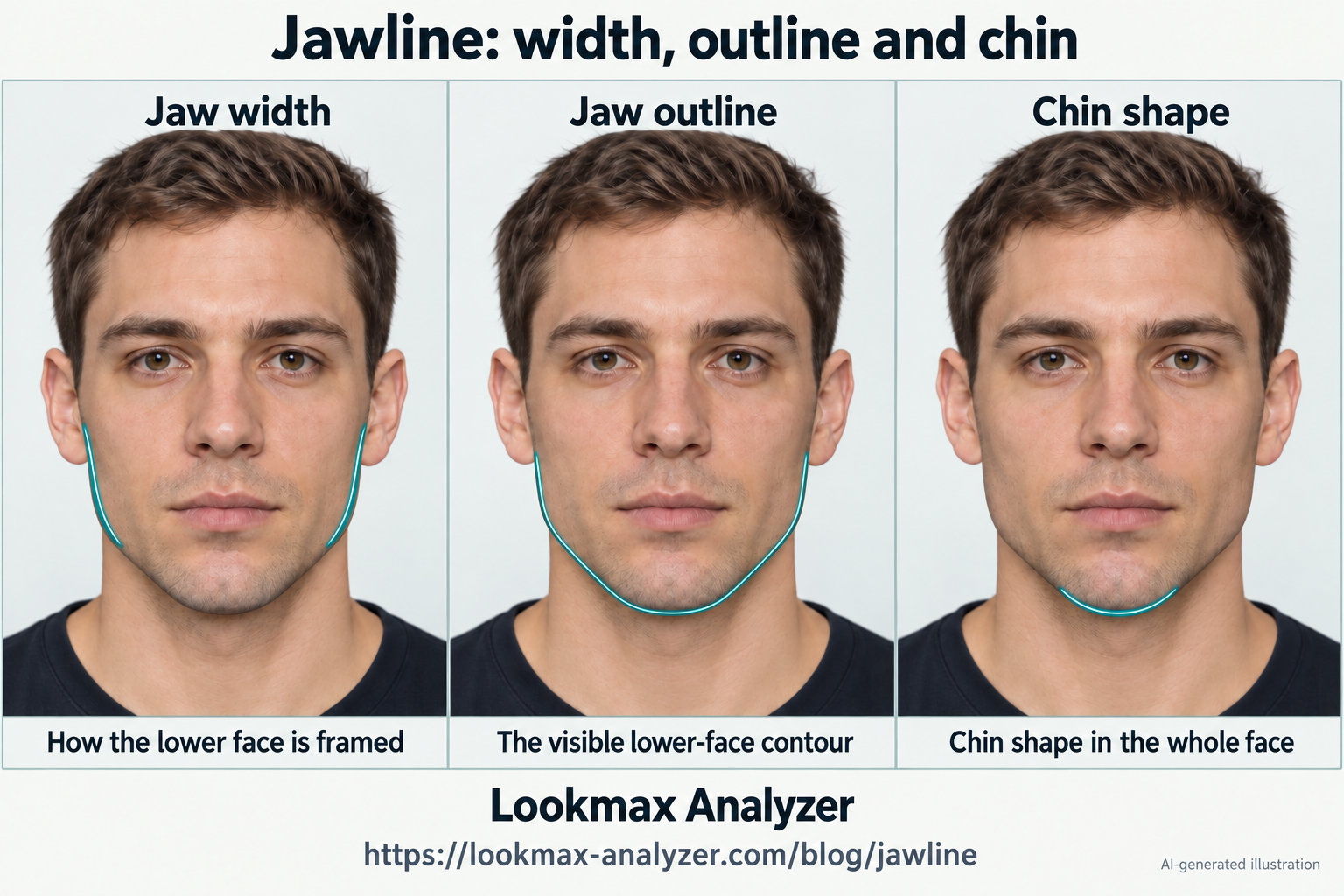
Attribution does not grant reuse rights. Read the image reuse terms.
Read the illustration description
Make Sense of Mixed Results#
Defined jaw, less prominent chin. You might notice clear jaw edges but a chin that draws less attention. Look at both parts of the lower face instead of expecting one strong feature to explain the entire result.
A sharper jaw in a turned portrait. A slight head turn can emphasize one edge and hide the other. Compare a relaxed frontal photo before deciding that the difference reflects a change in your face.
A beard changes the silhouette. Grooming can create a stronger-looking border while covering the outline the photo analysis needs. If the result is unclear, check whether the jaw is visible enough to assess.
These are everyday reading examples, not measured case studies. Treat the result as a guide to the submitted photo; a small score change is not, by itself, proof of improvement.
Take a Photo You Can Compare#
- Face the camera directly at eye height, with your head level.
- Use even light and keep both sides of the jaw visible.
- Relax your face and gently close your mouth. Avoid clenching or pushing the chin forward.
- Keep your camera distance and framing similar between photos, without a beauty filter.
If the photo-confidence indicator is low, start with a better capture. That is more useful than trying to explain every small difference between inconsistent photos.
Use the Result in Context#
A jawline score does not diagnose a bite problem or tell you which treatment or exercise to choose. It describes an appearance in a photo, with limits. The methodology explains how to interpret scores and confidence more broadly.
Common Jawline Analysis Questions#
- Why does my jawline look different in photos?
- Head angle, lighting, expression, camera distance and facial hair can change the visible outline. Compare photos taken with a similar setup.
- Can a defined jawline and a softer chin appear together?
- Yes. The jaw border and chin are different parts of the lower face. Consider both when reading the result.
- Should I use a side profile for the frontal analysis?
- Use the view requested by the tool. A side profile can help you understand your silhouette, but it does not replace a clear frontal photo.
Start a facial analysis for the free face-score preview, strongest supported signal and photo confidence. The detailed Jawline category is available in the optional paid breakdown.