
The TikTok Face Check Problem: Why One Score Can Hurt Your Confidence
4 min read
By Lookmax Analyzer Team — Updated Apr 5, 2026
A 20-second TikTok face check can feel like a verdict on your value. One score, one comment section, one bad angle, and suddenly uncertainty gets treated like truth. In a feed optimized for reaction, nuance is the first thing that disappears.
Shareable line: A face score can be data, but on social media it is often used as identity.
TL;DR: Viral face checks are not evil, but they are often used in the worst possible way: as identity labels instead of noisy snapshots. A single score should start a conversation, not end one.
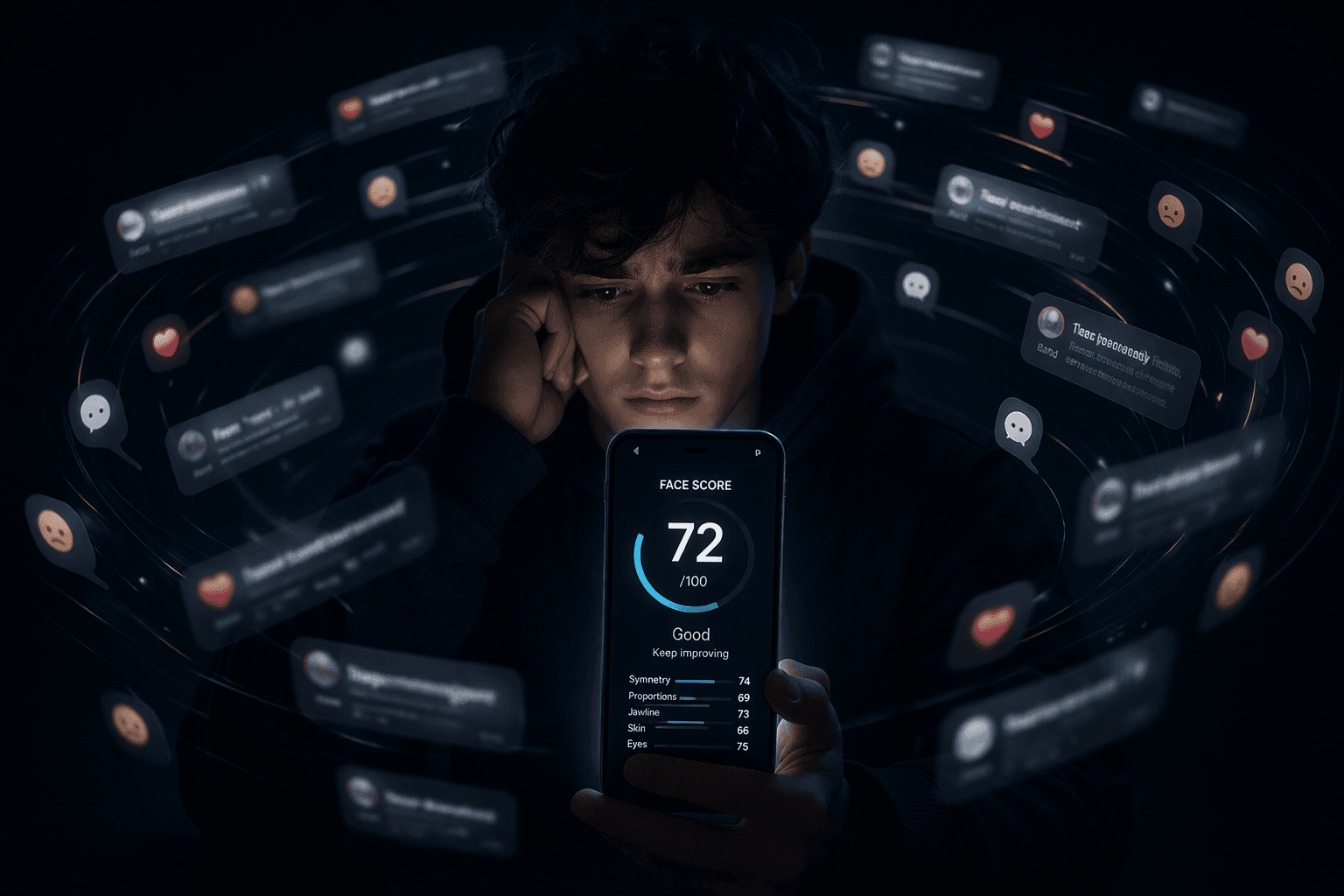
Social scoring pressure can turn one number into a public identity label.
Quick take#
TikTok made face analysis mainstream by making it fast, entertaining, and emotionally intense. That helped many people discover grooming, posture, and photography basics they never learned.
But platform incentives reward certainty, controversy, and reaction. So a probabilistic estimate gets framed as objective truth, and young users absorb it as self-worth.
The problem is not only the algorithm. It is the social framing: one score, public ranking, and a comment section that confuses entertainment with diagnosis.
If you want the technical side first, start with:
What face checks get right#
Face-check content did one useful thing: it made people aware that presentation is trainable. Better lighting, cleaner grooming, improved hairstyle structure, and neutral photo setup can dramatically change impressions.
It also normalized feedback loops. Instead of guessing forever, users can test changes, compare photos, and iterate.
That part is healthy. Measurement can be empowering when it serves behavior change.
Where they go wrong#
Most viral clips skip context. They show a score, maybe one hot take, and move on. Missing are reliability signals: was the head tilted, was the camera too close, was lighting asymmetric, was expression neutral?
Without that context, users compare numbers that were never captured under comparable conditions. That creates false conclusions: "I got worse" when the real difference was camera distance or light direction.
Shareable line: Most people are not comparing faces. They are comparing lighting setups and camera geometry.
These explain why setup errors can make features look more uneven than they are.
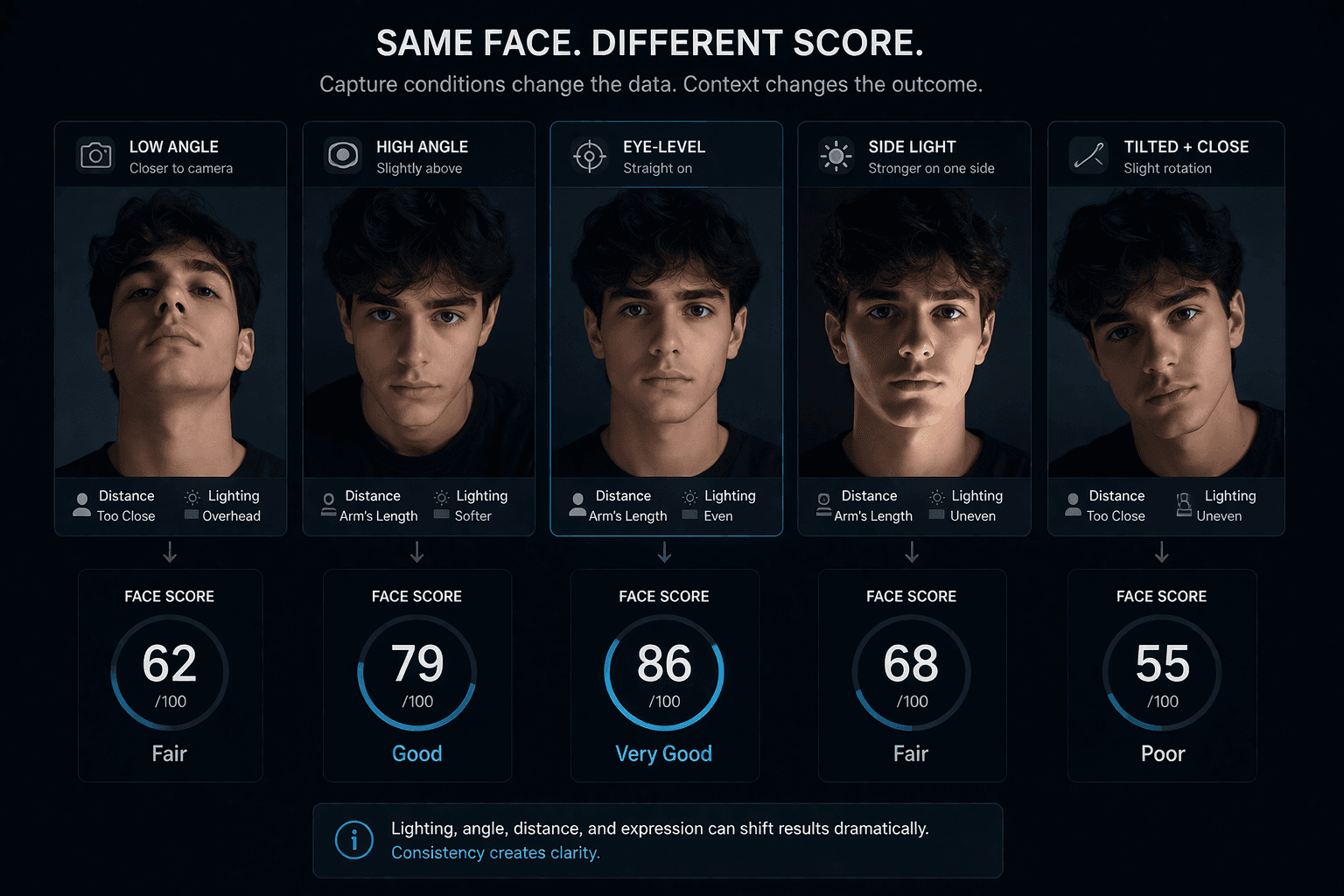
The same face can produce different scores when capture conditions change.
Why one score is not identity#
A face score is a model output from one image at one moment. It is not a statement about your personality, social value, future, or worth.
Standardized repeated results = trend.
Trends help you make decisions. Single snapshots mostly trigger emotion.
Shareable line: One result is a snapshot. Repeated results under the same conditions are a strategy.
If a result makes you feel worse, pause before interpreting it. Retake with neutral expression, eye-level framing, arm-length distance, and even light.
The confidence loop problem#
Here is the hidden risk with public face checks: one unstable score can create a persistent confidence loop.
Step 1: User posts a score. Step 2: Comment section anchors to the number. Step 3: User internalizes that label. Step 4: Anxiety grows, behavior becomes avoidant, and self-image narrows.
This loop can happen even when the score itself is technically "reasonable." Context collapse is what hurts: a nuanced metric gets compressed into a social ranking.
In short, the emotional cost comes from public interpretation, not just algorithm quality.
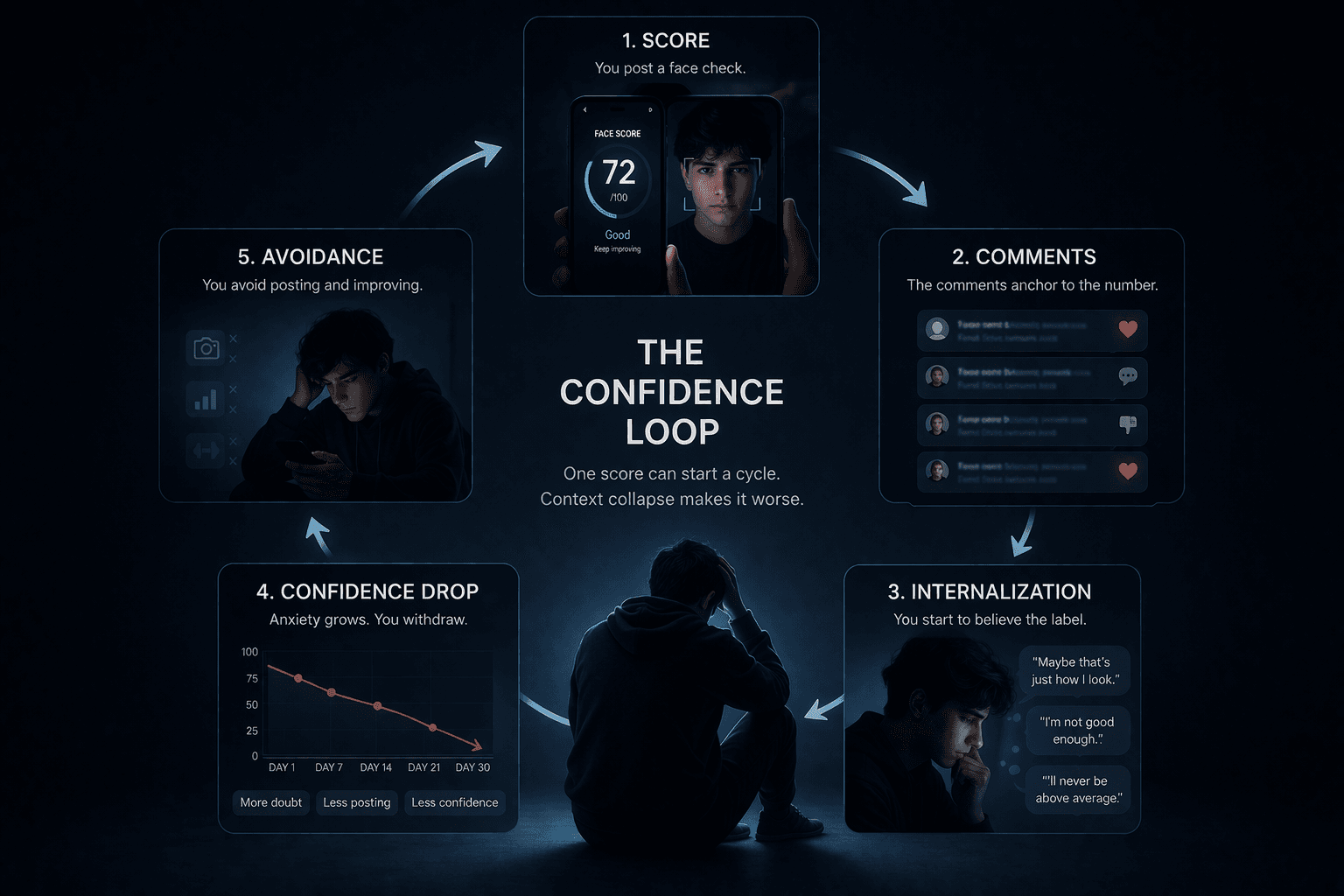
Public scoring can amplify negative self-talk over time.
A better way to use AI face analysis#
The fix is not "ban face analysis." The fix is better usage.
- Run analysis privately, not for public voting.
- Use a consistent photo protocol for comparisons.
- Track category trends over time, not one total score.
- Convert output into 2-3 concrete actions for the next two weeks.
- Judge progress by confidence and presentation, not only by numbers.
This turns AI from a judgment machine into a coaching tool.
For action-focused upgrades, pair this article with:
Platform responsibility#
If platforms host face-check trends, they should also reward better norms: confidence ranges, uncertainty labels, and prompts that discourage harassment.
Creators can help too by posting score context, photo setup, and realistic next steps instead of just a headline number.
For creators: better face-check content#
If you create face-check videos, you can keep them engaging without turning them into identity judgments. The strongest format is simple: show setup, show uncertainty, show actions.
- Show your camera distance and angle before sharing any score.
- Add a one-line disclaimer: "single photo estimate, not self-worth."
- Highlight category-level feedback, not only total score.
- Always end with 2-3 practical next steps people can actually try.
- Moderate comments that push harassment or body-shaming.
This approach still performs because people want transformation, not humiliation. Responsible framing attracts better audience quality and long-term trust.
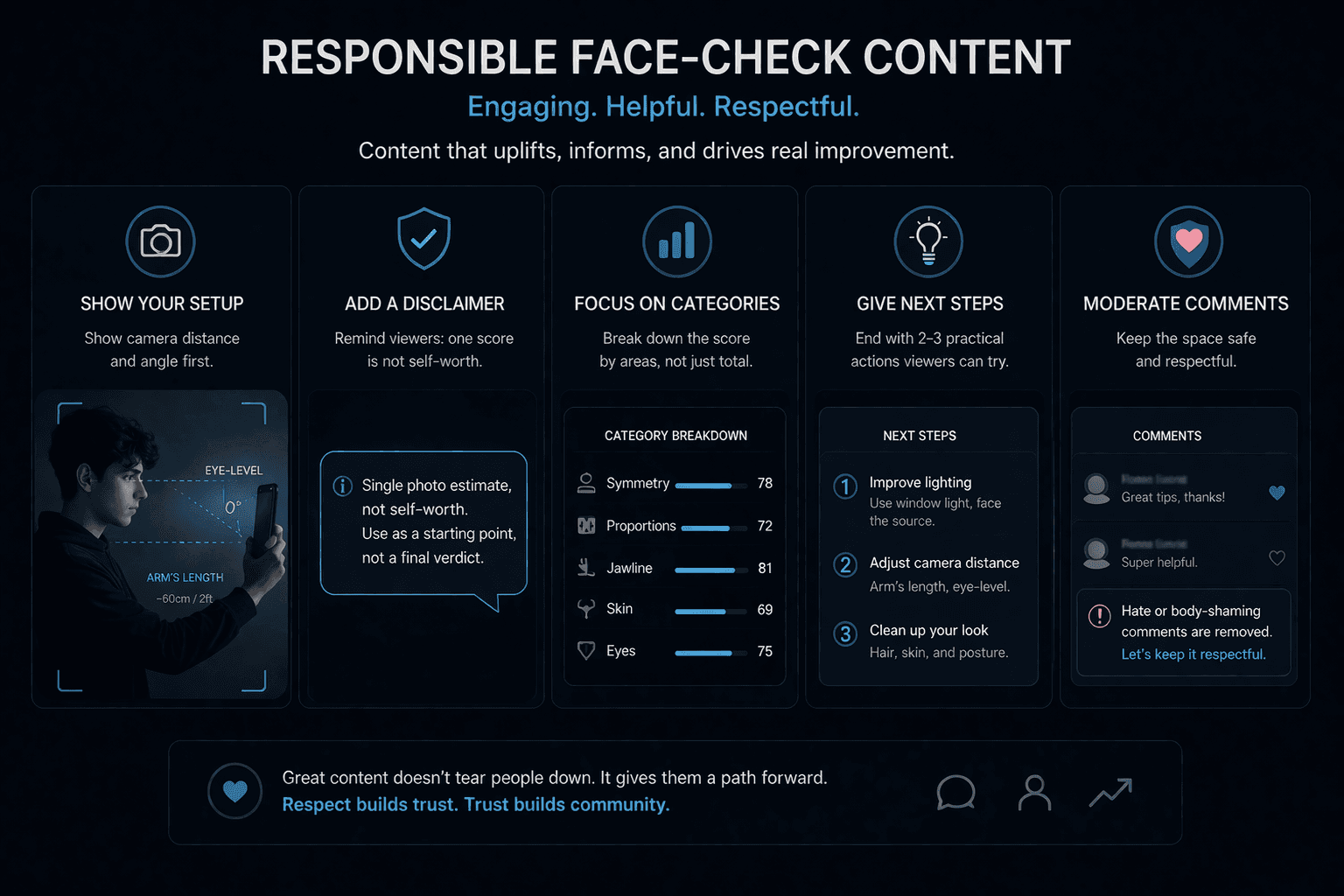
Face-check content can stay engaging without becoming harmful.
If a score hit your confidence#
If one result ruined your mood, that reaction is understandable. Social scoring is designed to feel personal even when it is technically uncertain.
A useful reset is to switch from evaluation mode to improvement mode:
- Retake under clean conditions (eye-level, neutral expression, even light).
- Ignore one-off totals; compare repeated captures only.
- Pick one grooming action and one photo action for the next 14 days.
- Unfollow creators that trigger shame instead of helpful instruction.
- Treat confidence as a metric too: if a tool worsens it, adjust how you use it.
The goal is not to "win" the internet on one upload. The goal is to become easier to read, healthier-looking, and more self-assured over time.
Use private analysis for decisions and public content for inspiration. Mixing those two usually creates anxiety.
Final thought#
A single face score can be useful, but only in the same way one weigh-in is useful: as one data point in a longer story.
The healthiest version of looksmaxxing is not self-punishment. It is structured self-improvement with dignity, context, and patience.
Shareable line: Use scoring as a mirror, not a sentence.