
Facial Proportions Explained: A Guide to Balanced Structure
3 min read
By Lookmax Analyzer Team — Mar 26, 2026
Facial Proportions Explained: A Guide to Balanced Structure
Whether you're curious about your facial balance or want to understand how proportions are evaluated, this guide covers what facial proportions mean, how they're measured, and practical ways to work with your features.
What Are Facial Proportions?#
Facial proportions refer to how different areas of your face relate to each other in size and position. The key divisions are the upper face (forehead), midface (eyes to nose), and lower face (nose to chin).
Side-profile discussions often call this relationship
forward growth
. That concept focuses on how projected the midface, jaw, and chin appear, while facial thirds describe their vertical balance from the front.
These proportions significantly impact how balanced and harmonious your face appears overall.
If you want to compare the visible relationships in your own photo, use the
free facial ratios calculator
. It covers facial thirds, midface balance, face-width relationships, eye spacing, and nose-to-mouth balance without treating any single number as a universal ideal.
Lookmax Analyzer evaluates proportions across three facial thirds:
Upper Third — forehead region
Middle Third — eye level to bottom of nose
Lower Third — bottom of nose to chin
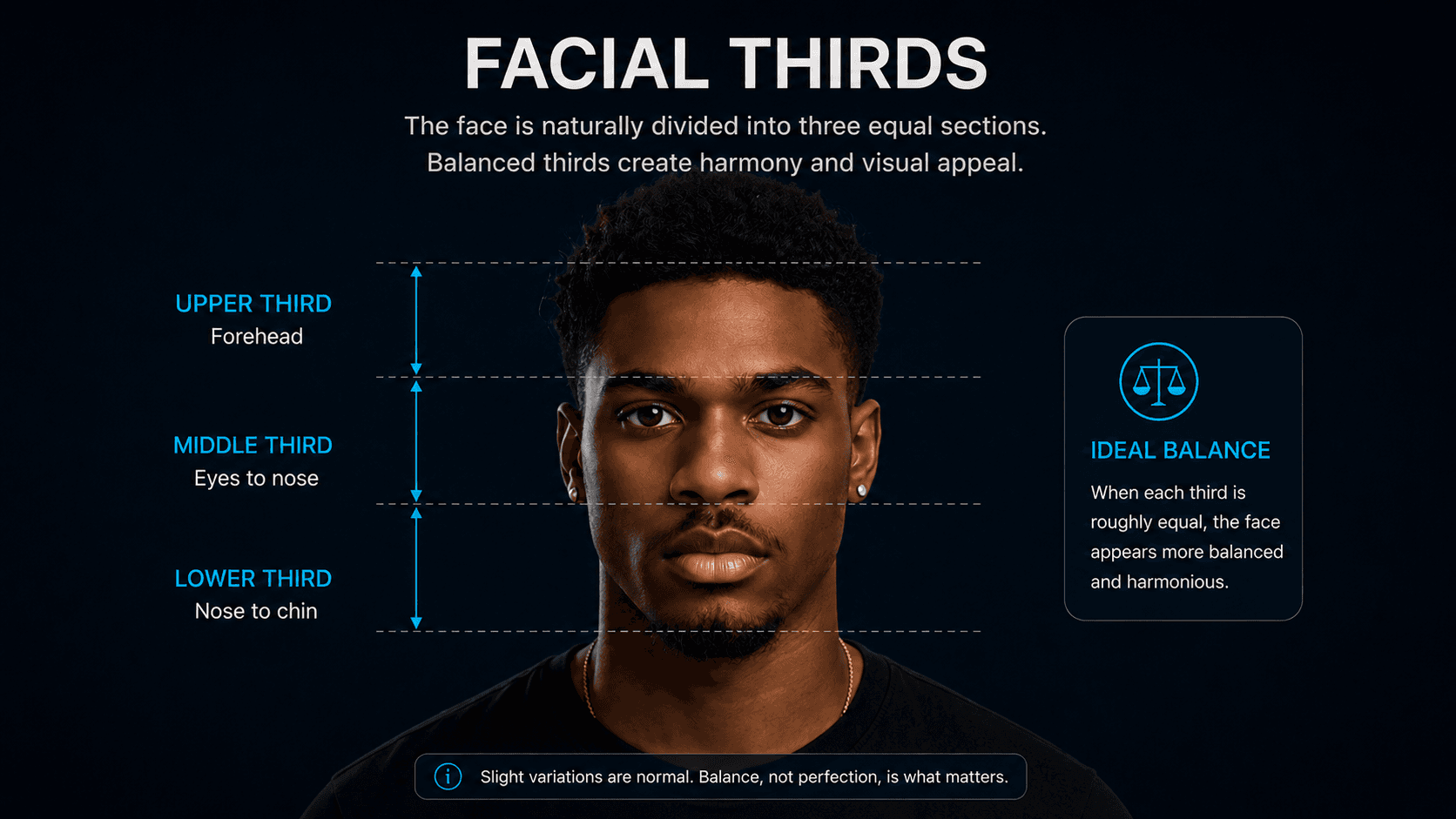
The three facial thirds: upper, middle, and lower
The Rule of Thirds#
The rule of thirds is a well-known principle in art and aesthetics. Applied to the face, it suggests that roughly equal thirds create visual balance:
Ideal Proportions
Upper third — from hairline to eyebrows
Middle third — from eyebrows to bottom of nose
Lower third — from bottom of nose to chin
Not One-Size-Fits-All
While the rule of thirds provides a useful guideline, slight variations are normal and can be attractive. Different aesthetic goals may favor slightly different proportions.
The rule of thirds is a guideline, not a strict rule. Many attractive faces have proportions that deviate slightly from perfect thirds.
Why Proportions Matter for Attractiveness#
Visual Balance
Well-proportioned faces appear balanced and harmonious. Proportions affect how different features relate to each other and create overall visual appeal.
Aesthetic Frameworks
Artists and facial surgeons have used proportional systems for centuries. These frameworks help identify what makes faces appear balanced and attractive.
Youth and Vitality
Certain proportions are associated with youth. For example, a slightly longer lower face can develop with age, while balanced thirds often read as more youthful.
Focus on overall balance rather than achieving perfect thirds. Small variations are part of what makes each face unique.
How Lookmax Analyzer Evaluates Proportions#
Our AI analyzes the three facial thirds and calculates how evenly they're distributed:
Upper third — forehead height relative to other thirds
Middle third — eye-to-nose area relative to other thirds
Lower third — nose-to-chin area relative to other thirds
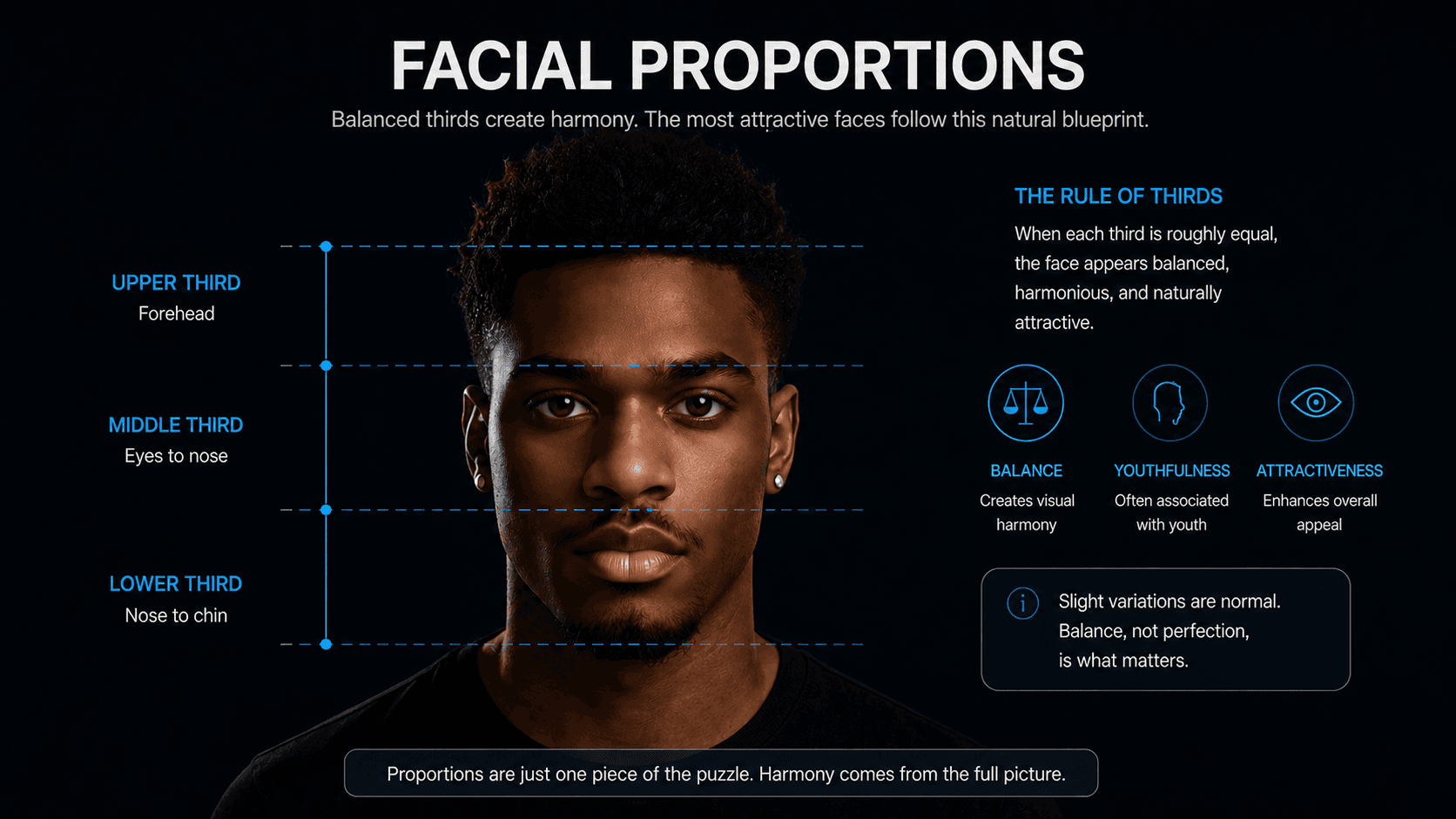
How facial thirds are measured
Each third is compared to ideal ranges, and an overall proportions score is calculated on a 0–100 scale.
The score is best used as a reference point. Higher scores usually mean your thirds are closer to common balance ranges, while lower scores often mean one third is more dominant.
For the most reliable comparison, use similar photos over time (same angle, distance, and lighting), since camera setup can shift how proportions appear.
Higher scores reflect more even distribution across the three facial thirds. Slight variations are normal and don't necessarily indicate imbalance.
Types of Proportional Imbalances#
Common Variations
Longer lower face — lower third is larger than upper or middle
Longer upper face — forehead is taller relative to other thirds
Longer middle face — eye-to-nose area is larger
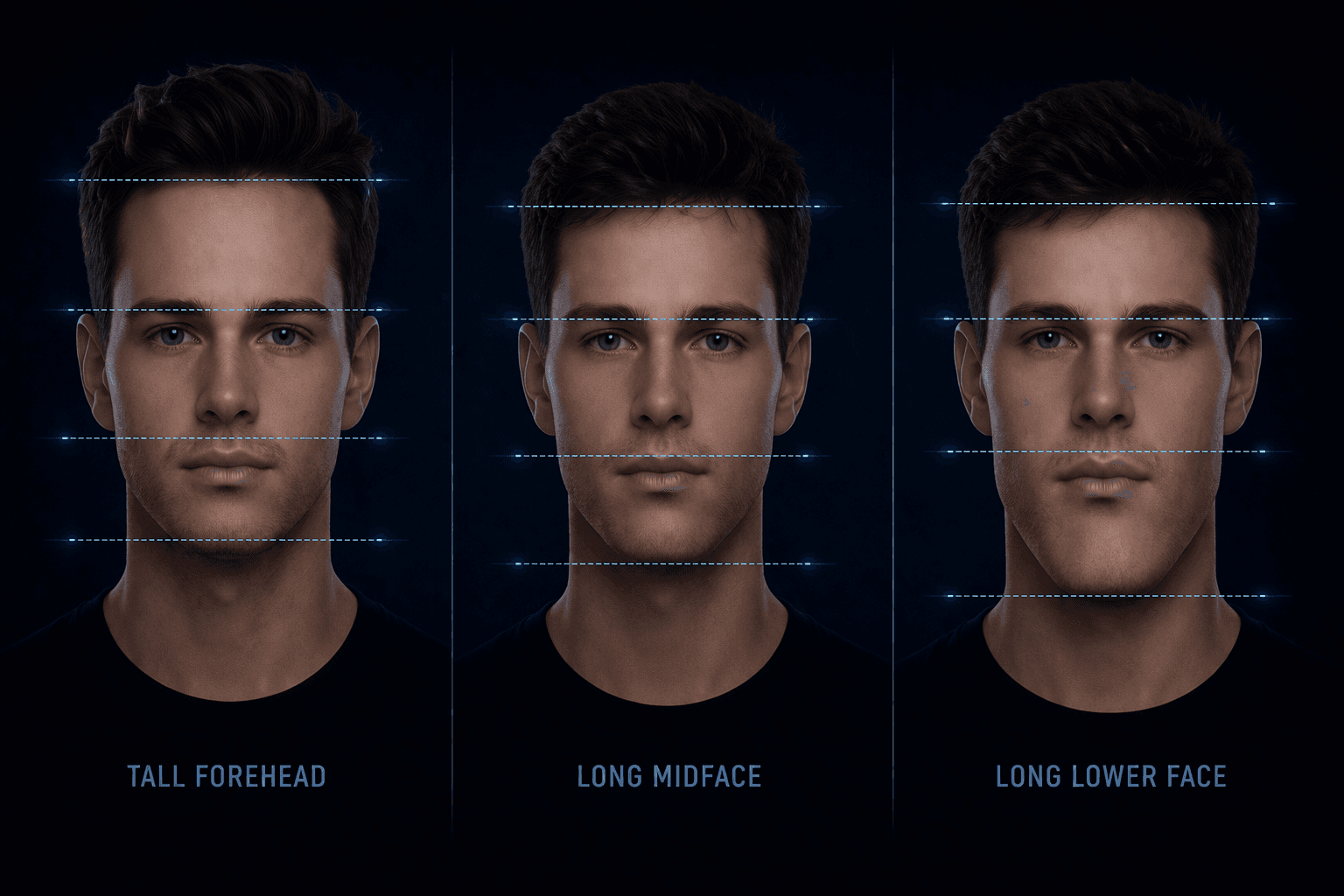
Common proportional variations
Most faces have at least slight proportional variations. These are normal and don't necessarily indicate unattractiveness.
Enhancing Facial Proportions#
1. Hairstyle
Hairstyle can significantly affect how facial proportions appear. Bangs can shorten the appearance of the forehead, while volume at certain levels can balance proportions visually.
2. Makeup
Strategic makeup can create illusions of more balanced proportions. Contouring, highlighting, and brow shaping can all help adjust apparent facial ratios.
3. Posture
Good posture with your head held high can affect how facial proportions appear. Looking down can foreshorten the lower face in photos.
4. Photography
Eye-level camera — shows proportions most accurately
Slight upward angle — can lengthen the lower face
Slight downward angle — can shorten the lower face
These approaches can help balance apparent proportions in photos and everyday life. They work with your existing structure rather than changing it.
Frequently Asked Questions#
- What are ideal facial proportions?
- The rule of thirds suggests roughly equal upper, middle, and lower facial thirds. However, slight variations are normal and many attractive faces don't have perfect thirds.
- Can facial proportions be changed?
- Bone structure is largely genetic and cannot be changed naturally. Hairstyle, makeup, and posture can affect how proportions appear. Surgical options exist for permanent changes.
- Does a longer lower face look unattractive?
- Not necessarily. While balanced proportions are often associated with attractiveness, many faces with longer lower thirds are considered attractive. It depends on overall facial harmony.
- What proportion score is considered good?
- Our analyzer uses internal reference ranges. Higher scores reflect more even distribution across facial thirds. Minor variations are normal and expected.
- Why do my proportions look different in photos?
- Camera angle significantly affects how proportions appear. The distance, angle, and lens all play a role. Eye-level positioning with even distance shows proportions most accurately.
Sources#
- PubMed (PMID: 41537730): The role of sagittal maxillary-mandibular relationships on perceptions of facial shape esthetics: A three-dimensional morphometric analysis
- PubMed (PMID: 41226978): Advanced 3D Facial Scanning in Orthodontics: A Correlative Analysis of Craniofacial Anthropometric Parameters
- PubMed (PMID: 41735422): Principal component analysis of 3-dimensional facial soft-tissue morphology in three adult populations
Ready to Analyze Your Facial Proportions?
Get your proportions score and personalized tips based on your facial structure.